
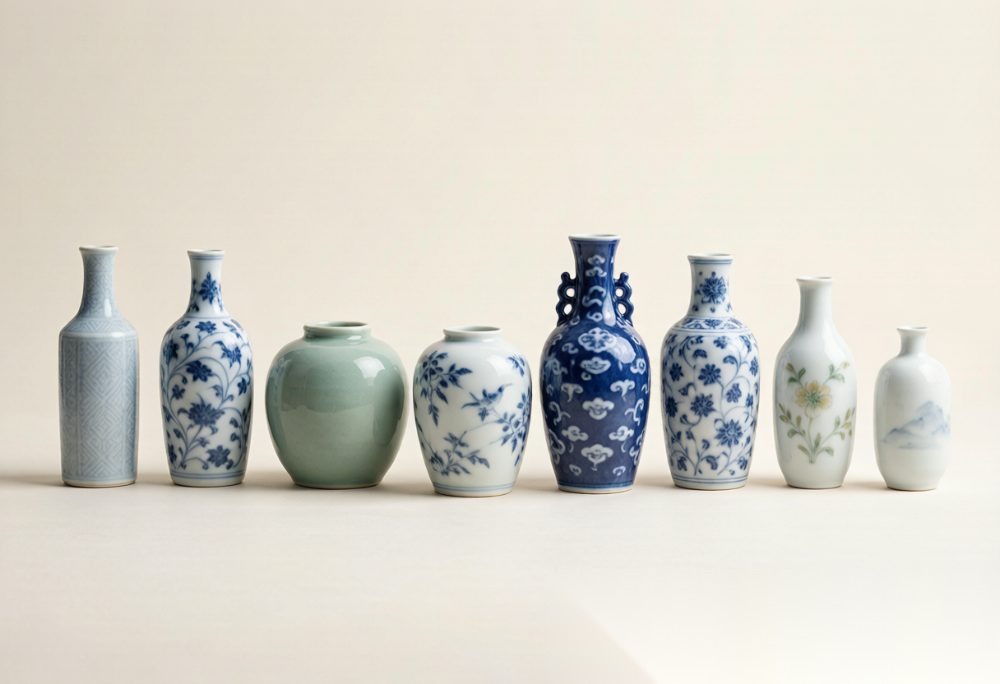
China porcelain history spans thousands of years, and it is a bright pearl in the world craft history. The following is the core summary of its development context:
I,Origin and Early Development (Pre-Qin to Wei, Jin, Southern and Northern Dynasties)
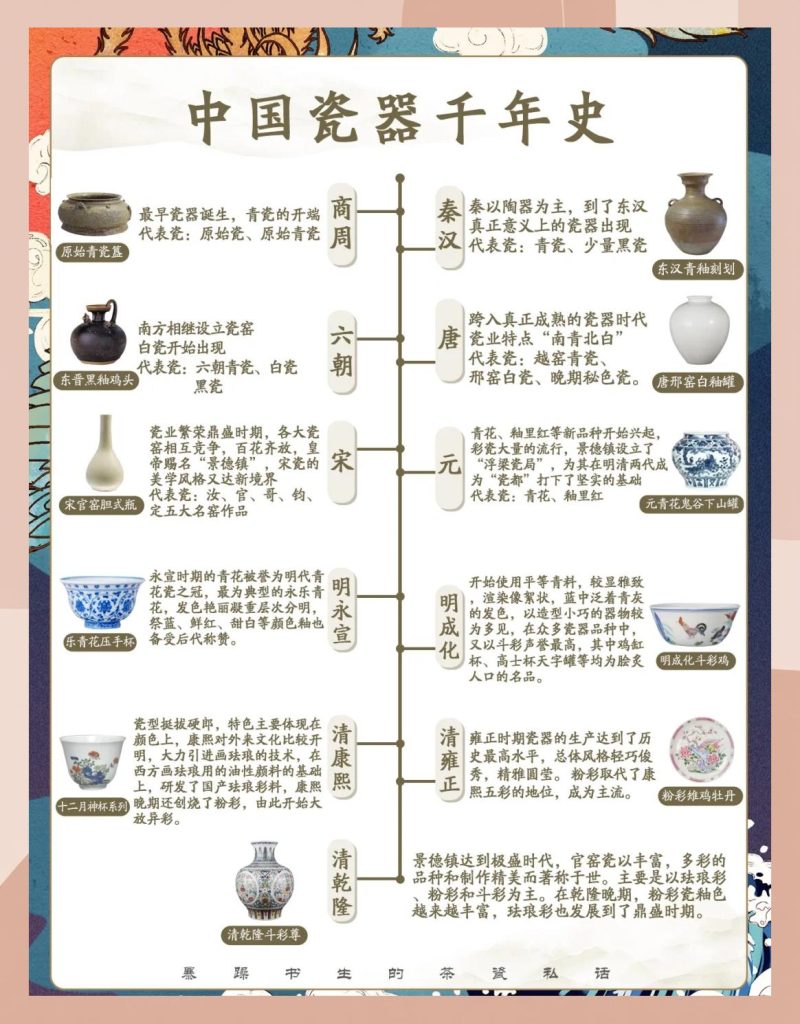
Neolithic Age: Primitive pottery appeared, such as painted pottery and black pottery.
Shang and Zhou Dynasties: Invented primitive celadon (glazed pottery), centering on Henan and Zhejiang.
Han dynasty to Wei and Jin dynasties: celadon technology was mature (represented by Yue kiln in Zhejiang), and early black porcelain appeared.
2, the South, the North, the White and Prosperity (Sui, Tang and Five Dynasties)
Sui and Tang dynasties: the pattern of “blue in the south and white in the north” was formed-celadon from Yue kiln in the south (jade like ice) and white porcelain from Xing kiln in the north (silver like snow).
Innovation in Tang dynasty:Changsha Kiln initiated underglaze painting.Tri-colored pottery (tri-colored pottery in Tang Dynasty) flourished.
Five Dynasties: Secret porcelain (the peak of Yueyao) became the exclusive product of the court.
3,Famous Kilns and Aesthetic Peak (Song, Liao, Jin and Yuan Dynasties)
Five famous kilns in Song Dynasty:
①Ru kiln: azure glaze, moist and subtle, rarely handed down from generation to generation.
②Official Kiln/Ge Kiln: Open grain (gold wire)
③Ding kiln: white porcelain carving, covering firing process
④Jun Kiln: The glaze color of the kiln changed, “One color in the kiln, and a thousand colors in the kiln”.
Famous folk kilns:
①Yaozhou Kiln: Celadon carved with sharp flowers.
②Cizhou Kiln: White ground and black flowers, folk style.
③Longquan kiln: pink green and plum green glaze.
④Jingdezhen Kiln: Celadon (celadon). Because Song Shenzong likes the porcelain here best, he changed Changnan Town to Jingdezhen with his own year number.
Breakthrough in Yuan Dynasty:
Jingdezhen became the center, creating blue-and-white porcelain (painted with cobalt) and underglaze red.
Egg white glaze (official porcelain) is the basis of official system.
4, the court dominated and the peak of skills (Ming and Qing Dynasties)
Ming dynasty:
Jingdezhen set up imperial kiln factory, and the government and the people competed in the market.
Blue-and-white porcelain flourished (Yong Xuan Su Ma Li Qing, Chenghua Ping Dengqing)
Create and burn fighting colors (Chenghua) and multicolored (Jiajing Wanli)
Technical progress of monochromatic glaze (Yongle sweet white, Xuande red sacrifice)
Qing dynasty:
Kangxi multicolored, Yongzheng pastel (soft rendering), enamel (palace western style)
Antique and innovation are equally important, and colored glaze is rich (Lang Yaohong, carmine).
After drying, the process became more and more complicated, and exporting porcelain affected European porcelain making.
5,Modern Transformation and Modern Revival (Late Qing Dynasty to present)
Late Qing dynasty: the decline of traditional official kilns and the maintenance of folk porcelain industry.
20th century to present:
Exploration of Antique Porcelain and Artistic Porcelain in the Republic of China
After the founding of New China, the famous kiln techniques (such as Longquan and Jun kilns) were restored.
Support the development of Jingdezhen and other porcelain cities, integrate traditional skills and modern design in contemporary times, and diversify the development of ceramic art.
Core influence
Technical contribution: high-temperature glaze, painting, kiln transformation and other processes have far-reaching influence on the world.
Sino-foreign exchange: since the Tang and Song Dynasties, the Silk Road and maritime trade have been exported to promote cultural exchanges between China and foreign countries.
Cultural symbol: China has become China’s cultural business card, which embodies oriental aesthetics and craftsman spirit.
The history of China porcelain is an epic of technological innovation and aesthetic evolution. From practical devices to works of art, it carries the trajectory of the wisdom of the Chinese nation and the dialogue between civilizations.
contact us:
Call:+86 17601337331
Site:zhejiangceramics.com
Location:No.33 Dashikou Village, County Ya Road, Fuliang County, Jingdezhen City, Jiangxi Province, China
Email:postmaster@zhejiangceramics.com;Jame@zhejiangceramics.com
Discover more from Zhejiang Ceramics (Jingdezhen)
Subscribe to get the latest posts sent to your email.