
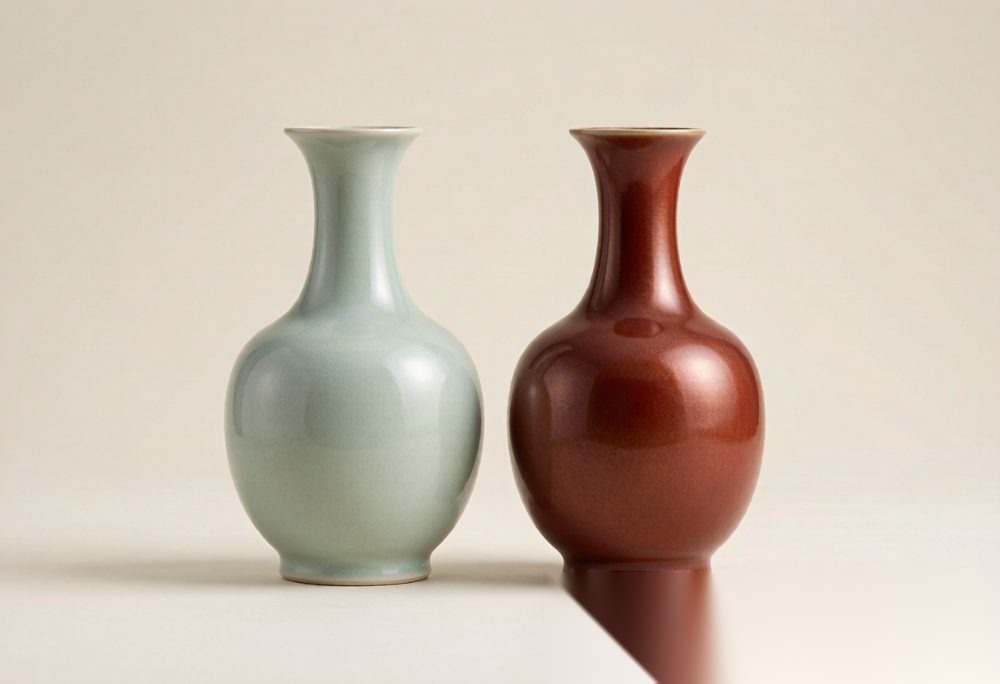
When most people think of Jingdezhen porcelain, they picture the iconic blue and white ware that has captivated collectors for centuries. But the “Porcelain Capital” has a far richer palette than just cobalt blue — its glaze traditions span a spectrum from the icy greens of celadon to the deep, lustrous crimson of copper red. Understanding these glazes will deepen your appreciation for every piece in your collection.
The Four Pillars of Jingdezhen Glaze Tradition
Jingdezhen’s glazing heritage rests on four technical pillars, each representing a different chapter in the city’s thousand-year ceramic history.
1. Qingbai (青白) — Bluish-White / Yingqing
Before blue and white dominated the world stage, Jingdezhen was famous for qingbai (青白), also known as yingqing (影青) or “shadowy blue.” Fired at temperatures exceeding 1300°C, qingbai glaze contains a trace amount of iron that produces a faint bluish-green tint — like the color of jade seen through morning mist.
How to identify it: Look for a translucent, glass-like finish with carved or incised decoration beneath. The glaze pools slightly in carved recesses, creating deeper blue-green highlights. Song Dynasty (960-1279) qingbai pieces are among the most prized by serious collectors.
Best for: Tea sets, small bowls, and vases where the subtle color can be appreciated up close.
2. Celadon (青瓷) — The Jade of Ceramics
Celadon — known in Chinese as qingci (青瓷) — is perhaps the most philosophically significant of all Chinese glazes. Its characteristic green color (ranging from pale sage to deep olive) comes from iron oxide fired in a reduction atmosphere. The goal of the celadon potter has always been to imitate jade, the most precious material in traditional Chinese culture.
The science behind the color: When iron-rich glaze is fired in a kiln with limited oxygen (reduction firing), the iron transforms from ferric (Fe³⁺, which produces yellowish-brown) to ferrous (Fe²⁺, which produces bluish-green). Jingdezhen’s master potters spent generations perfecting this delicate chemical dance.
Famous types: Longquan celadon from nearby Zhejiang province is the benchmark, but Jingdezhen’s own celadon tradition — particularly from the Southern Song through Yuan periods — rivals it in quality and surpasses it in variety.
3. Underglaze Copper Red (釉里红) — The Alchemist’s Dream
If celadon is the philosopher among Jingdezhen glazes, copper red is the alchemist. Achieving a stable, vibrant red color requires reducing copper oxide in an extremely narrow temperature and atmosphere window — a few degrees too hot or too much oxygen, and the red either fades to grey or disappears entirely.
The Yuan Dynasty (1271-1368) saw the first successful large-scale production of copper red at Jingdezhen, but it was the early Ming — specifically the Xuande period (1426-1435) — that produced the legendary “sacrificial red” (jihong, 祭红) pieces. Named for their use in imperial sacrificial rituals, these deep crimson vessels represented the absolute pinnacle of the potter’s art.
Collector’s note: Genuine Ming copper red pieces are exceptionally rare and command premium prices. Modern Jingdezhen artisans continue the tradition with remarkable fidelity, producing pieces that capture the same depth and vibrancy at accessible price points.
4. Underglaze Blue (青花) — The Global Icon
No discussion of Jingdezhen glazes would be complete without cobalt blue (青花, qinghua). While the blue and white palette is the most recognized worldwide, its technical achievement deserves equal appreciation alongside its aesthetic appeal.
Why cobalt? Unlike copper and iron, cobalt oxide remains stable across a wide temperature range and in both oxidizing and reducing atmospheres. This reliability allowed Jingdezhen potters to scale production to meet global demand — first across Asia, then through the Middle East, and finally to Europe, where “china” became synonymous with blue and white porcelain.
Quality markers: Premium Jingdezhen blue and white uses imported cobalt (historically “Mohammedan blue” from Persia, now high-grade synthetic cobalt) that produces a deep, slightly purplish blue with characteristic “heaping and piling” effects in thick areas.
How to Choose Based on Glaze
| If You Want… | Choose… |
|---|---|
| Subtle elegance for daily tea | Qingbai / Yingqing glaze |
| Timeless classical beauty | Celadon green glaze |
| A statement piece with wow factor | Copper red glaze |
| Versatile tableware for any setting | Cobalt blue and white |
| A collector’s investment | Museum-grade reproductions of any glaze type |
The Hallmarks of a Quality Glaze
Regardless of glaze type, authentic Jingdezhen pieces share certain quality indicators:
- Smooth, even coverage — No thin spots, drips, or pinholes in the glaze surface
- Depth of color — The glaze should appear to have dimension, not sit flat on the surface
- Appropriate translucency — High-quality porcelain allows light to interact with the glaze from within
- Clean foot rim — The unglazed foot should show the fine, dense body characteristic of Jingdezhen kaolin
- Consistent firing — No warping, cracking, or kiln debris embedded in the glaze
At Zhejiang Ceramics, every piece in our collection undergoes rigorous quality inspection to ensure it meets these exacting standards. From qingbai tea cups to copper red display vases, we source directly from Jingdezhen’s finest workshops.
Ready to start or expand your collection? Browse our latest arrivals or contact us for wholesale inquiries.
Discover more from Zhejiang Ceramics (Jingdezhen)
Subscribe to get the latest posts sent to your email.