
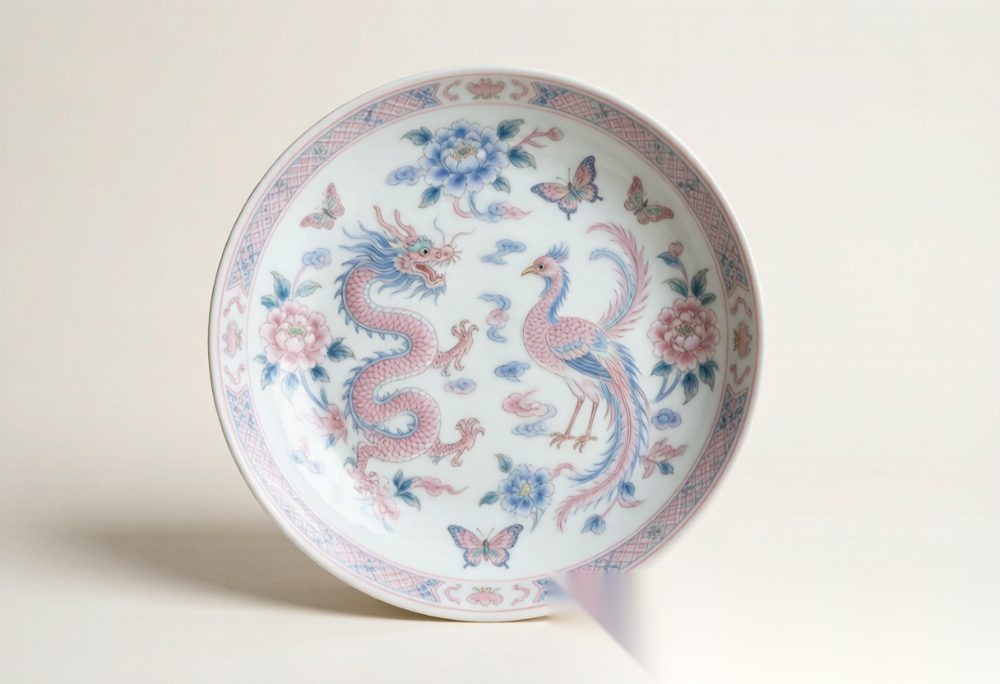
Walk into any serious collection of Chinese porcelain and you will notice something beyond the shapes and glazes: the surfaces teem with dragons, phoenixes, flowers, and fish — each one a deliberate choice carrying centuries of cultural meaning. To the untrained eye, a peony is just a flower and a fish is just a fish. But to the Chinese craftsman who painted it, and to the collector who understands the language of motifs, every stroke tells a story. This guide decodes the most important patterns found on Jingdezhen porcelain, so you can read every piece like an open book — and make smarter collecting decisions.
Why Patterns Matter: The Visual Language of Chinese Porcelain
Chinese decorative art has never been merely ornamental. For over a thousand years, Jingdezhen’s master painters have embedded wishes, philosophical ideas, and social commentary into the designs they painted onto porcelain. A bowl given as a wedding gift might feature paired fish for marital harmony; a vase commissioned for a scholar’s study might display the Four Gentlemen (四君子) — plum, orchid, bamboo, and chrysanthemum — symbolizing moral integrity.
Understanding this visual vocabulary transforms porcelain appreciation from a purely aesthetic experience into a cultural conversation that spans dynasties. More practically, it helps you distinguish authentic, culturally informed pieces from modern reproductions that slap motifs together without understanding their meaning.
The Principle of Auspicious Homophones
One key to decoding Chinese porcelain patterns is the concept of rebus symbolism — using visual images to represent words that sound similar but carry auspicious meanings. In Chinese, many words share identical pronunciations. A bat (fú, 蝠) sounds exactly like the word for good fortune (fú, 福). A fish (yú, 鱼) sounds like the word for surplus or abundance (yú, 余). This linguistic quirk gave Jingdezhen painters an entire parallel vocabulary to work with, layering hidden blessings into seemingly straightforward decorative scenes.
The Dragon (龙) — Power, Authority, and Imperial Majesty
No motif is more synonymous with Chinese porcelain than the dragon. But the dragon on Jingdezhen ware is not the fire-breathing monster of Western mythology — it is a celestial being, a bringer of rain, and the ultimate symbol of yang (阳) masculine energy.
How to Read Dragon Motifs
- Five-clawed dragon (五爪龙): Reserved exclusively for the emperor and imperial household. Finding a five-clawed dragon on a piece almost certainly dates it to imperial commission — or marks it as a deliberate reproduction of imperial ware.
- Four-clawed dragon (四爪龙): Used by princes, high-ranking officials, and the nobility. Far more common on porcelain made for the elite market rather than the throne.
- Three-clawed dragon (三爪龙): Generally seen on export porcelain and pieces for the wider domestic market.
Dragon chasing flaming pearl (龙戏珠): One of the most iconic compositions. The pearl represents wisdom, spiritual energy, or the moon — and the dragon’s pursuit symbolizes the never-ending quest for enlightenment. On blue and white porcelain, this motif reached its artistic peak during the Xuande (1426-1435) and Chenghua (1465-1487) reigns of the Ming Dynasty.
Double dragons (双龙): Two dragons facing each other, often flanking a central motif. This arrangement carries the specific meaning of “双龙戏珠” — twin dragons sporting with a pearl — symbolizing harmony between opposing forces and the balance of yin and yang.
Best for: Statement vases, large charger plates, and pieces intended as gifts for people in leadership positions. A dragon piece communicates ambition, protection, and supreme good fortune.
The Phoenix (凤) — Harmony, Rebirth, and Feminine Grace
If the dragon represents the emperor, the phoenix (fenghuang, 凤凰) represents the empress. Together, dragon and phoenix form the ultimate pairing in Chinese iconography — the perfect marriage of yang and yin energies, imperial power and benevolent grace.
Identifying Authentic Phoenix Depictions
The Chinese phoenix bears little resemblance to its Western counterpart. Look for these distinctive features:
- A pheasant-like head with a distinctive crest
- A long, flowing tail with eye-spot feathers (reminiscent of a peacock)
- Often surrounded by peony flowers, clouds, or flames
- Typically depicted in flight or perched gracefully rather than rising from flames
Dragon and Phoenix together (龙凤呈祥): This is perhaps the most auspicious pairing in all of Chinese decorative arts. “龙凤呈祥” translates to “dragon and phoenix bringing prosperity.” You will find this motif overwhelmingly on wedding porcelain — tea sets, bowls, and vases given as marriage gifts. The dragon represents the groom, the phoenix the bride, and together they promise a harmonious, blessed union.
Best for: Wedding gifts, anniversary presents, and any piece celebrating partnership. Phoenix-only pieces are excellent gifts for women in positions of achievement and grace.
The Peony (牡丹) — Wealth, Honor, and Feminine Beauty
Known as the “King of Flowers” (花王) in Chinese culture, the peony (mǔdān, 牡丹) has been China’s unofficial national flower for over a thousand years. On Jingdezhen porcelain, the peony carries an unmistakable message: wealth, high social status, and flourishing prosperity.
Peony Variations and Their Meanings
| Composition | Chinese Name | Meaning |
|---|---|---|
| Peony alone, full bloom | 牡丹富贵 | Pure wealth and honor; “may you be rich and noble” |
| Peony with magnolia | 玉堂富贵 | “Jade hall of wealth” — wishes for a prosperous, honorable household |
| Peony with crabapple | 满堂富贵 | “Wealth filling the entire hall” — abundance for the whole family |
| Peony with butterfly | 蝶恋花 | “Butterfly loves flower” — romantic love and marital bliss |
| Peony with phoenix | 凤穿牡丹 | “Phoenix threading through peonies” — supreme feminine elegance and good fortune |
On Famille Rose (粉彩) porcelain — which Jingdezhen perfected during the Qing Dynasty — peonies are rendered in delicate shades of pink to white, with layered petals that seem to glow against the white porcelain body. On blue and white ware, the peony is executed with confident, flowing brushstrokes that emphasize the flower’s lush, full form.
Best for: Business gifts, home décor for living rooms and entryways, and any piece meant to attract prosperity. A large peony vase in a shop or office entrance is considered excellent feng shui.
The Lotus (莲花) — Purity, Enlightenment, and Rising Above
The lotus (liánhuā, 莲花) holds a special place in Chinese culture that bridges Buddhist philosophy and Confucian values. Growing from muddy water yet emerging pristine and untainted, the lotus represents the ideal of maintaining moral purity in an imperfect world.
Lotus Symbolism Across Contexts
- Buddhist context: The lotus is the throne of Buddha and bodhisattvas, symbolizing spiritual enlightenment and detachment from worldly desires. A piece featuring lotus alongside Buddhist emblems (the Eight Auspicious Symbols, 八吉祥) was likely made for a temple or devout Buddhist household.
- Confucian context: The lotus represents the virtuous gentleman (jūnzǐ, 君子) — one who remains uncorrupted despite surrounding moral decay. Song Dynasty scholar Zhou Dunyi’s famous essay “On the Love of the Lotus” cemented this interpretation.
- Auspicious homophone: “莲” (lián, lotus) sounds like “连” (lián, continuous). A lotus with a fish creates “连年有余” — “may you have surplus year after year.”
The lotus scroll (缠枝莲): One of the most enduring patterns in Chinese porcelain history. Continuous, meandering lotus vines with blossoms at intervals represent endless continuity and eternal life. This pattern was particularly beloved during the Yuan and early Ming dynasties and remains one of the most collected motifs today.
Best for: Scholar’s objects (brush pots, water droppers), tea ware for contemplative brewing, and gifts for those who value spiritual or intellectual pursuits.
Fish (鱼) — Abundance, Freedom, and Marital Joy
Few motifs appear as frequently — or as joyfully — on Chinese porcelain as fish. Through the magic of the Chinese language, fish (yú, 鱼) is a perfect homophone for surplus or abundance (yú, 余), making it one of the most auspicious symbols available to the Jingdezhen painter.
Fish Species and Their Specific Meanings
| Fish Type | Symbolism | Common Context |
|---|---|---|
| Carp (鲤鱼, lǐyú) | Success in examinations, career advancement, perseverance. Based on the legend of the carp leaping over the Dragon Gate waterfall to transform into a dragon. | Graduation gifts, career milestone celebrations, scholar’s desk objects |
| Goldfish (金鱼, jīnyú) | “金” = gold/wealth, “鱼” = abundance → “gold in abundance.” Also “金玉” (jīnyù) = “gold and jade” — a homophone for precious treasures. | Business gifts, Lunar New Year pieces, prosperity-themed décor |
| Paired fish (双鱼) | Marital harmony, fidelity, and conjugal bliss. Two fish swimming together represent a couple in perfect accord. | Wedding gifts, anniversary porcelain, bedroom décor |
The nine-fish composition (九鱼图): Nine fish swimming among water weeds is a classic composition on Jingdezhen porcelain. “九” (nine) sounds like “久” (long-lasting), so nine fish means “abundance that lasts forever.” This is among the most popular motifs on contemporary Jingdezhen pieces for the domestic Chinese market.
Best for: Dining ware — plates, bowls, and serving platters featuring fish are traditional favorites. Also excellent for Lunar New Year gifting.
Auspicious Minor Motifs: Bats, Butterflies, Clouds, and Waves
Beyond the major motifs, Jingdezhen porcelain frequently employs a supporting cast of smaller symbolic elements. These “background” decorations are never accidental — they enrich and amplify the meaning of the main motif.
Bats (蝠, fú)
The bat — perhaps surprisingly to Western eyes — is one of the most beloved symbols in Chinese art. Because “蝠” sounds exactly like “福” (good fortune), bats appear everywhere on porcelain. Five bats (五福) represent the Five Blessings: longevity, wealth, health, love of virtue, and natural death. Red bats are especially auspicious, as “红蝠” (hóngfú) sounds like “鸿福” — vast good fortune.
Butterflies (蝶, dié)
“蝶” sounds like “耋” (dié), meaning a person in their seventies or eighties — so butterflies carry wishes for longevity. Paired with the cat character (猫, māo, which sounds like 耄, mào — a person in their eighties or nineties), butterflies create “猫蝶图” — a wish for extreme old age. Butterflies also symbolize young love and romantic joy, especially when paired with flowers.
Clouds (云, yún) and Waves (浪, làng)
“云” sounds like “运” (luck/fortune), so auspicious clouds (祥云) literally carry good fortune into the composition. Stylized wave patterns — especially the distinctive spiral waves of the early Ming — represent the ocean’s power and endless vitality. On dragon pieces, clouds and waves frame the dragon as a celestial being commanding the elements.
How to Choose Porcelain by Pattern: A Collector’s Practical Guide
Understanding the symbolic language of Chinese porcelain patterns is not just an academic exercise — it directly informs smarter purchasing decisions. Here is how to apply this knowledge in practice:
1. Match the Pattern to the Occasion
A dragon-and-phoenix tea set for a wedding. A peony vase for a business opening. A lotus brush pot for a graduating student. When the pattern aligns with the occasion, the gift becomes genuinely meaningful rather than generically decorative. This cultural literacy is what separates a thoughtful collector from a casual buyer.
2. Check Pattern Authenticity
Mass-produced reproductions frequently combine motifs that would never appear together on an authentic piece. A five-clawed dragon on a rustic kitchen bowl? That would be like putting a royal crest on a paper cup — it signals a factory that does not understand (or care about) the cultural language of the patterns they paint.
3. Consider the Piece’s Original Purpose
When you encounter a vintage or antique piece, let the pattern guide you to its original function. A bowl covered with paired fish and lotus was almost certainly a wedding gift. A vase dense with scholarly motifs — prunus, orchid, bamboo, chrysanthemum — was commissioned by or for a member of the literati class. Reading the patterns helps you reconstruct the object’s biography.
4. Build Thematic Collections
Many serious collectors organize their acquisitions around a single motif — a collection built around dragon porcelain, or fish, or the Four Gentlemen. Thematic collecting not only provides a clear focus but also allows you to trace how a single motif evolved across different dynasties, glaze types, and vessel forms. Few collecting experiences are more intellectually satisfying.
5. Trust Jingdezhen Craftsmanship
The patterns described in this guide reached their highest expression at Jingdezhen, where master painters train for years — sometimes decades — to master the brushwork required for each motif. The confidence of line, the subtlety of shading, and the compositional balance found on a genuine Jingdezhen piece cannot be replicated by machine printing or mass-production studios.
Ready to explore authentic Jingdezhen porcelain with meaningful, culturally informed patterns? Browse our curated collection of hand-painted porcelain, where every motif carries the weight of a thousand-year artistic tradition. For wholesale inquiries and custom commissions, contact our team — we work directly with Jingdezhen’s finest studios to bring you porcelain that speaks the language of symbols as fluently as it speaks the language of beauty.
Discover more from Zhejiang Ceramics (Jingdezhen)
Subscribe to get the latest posts sent to your email.