
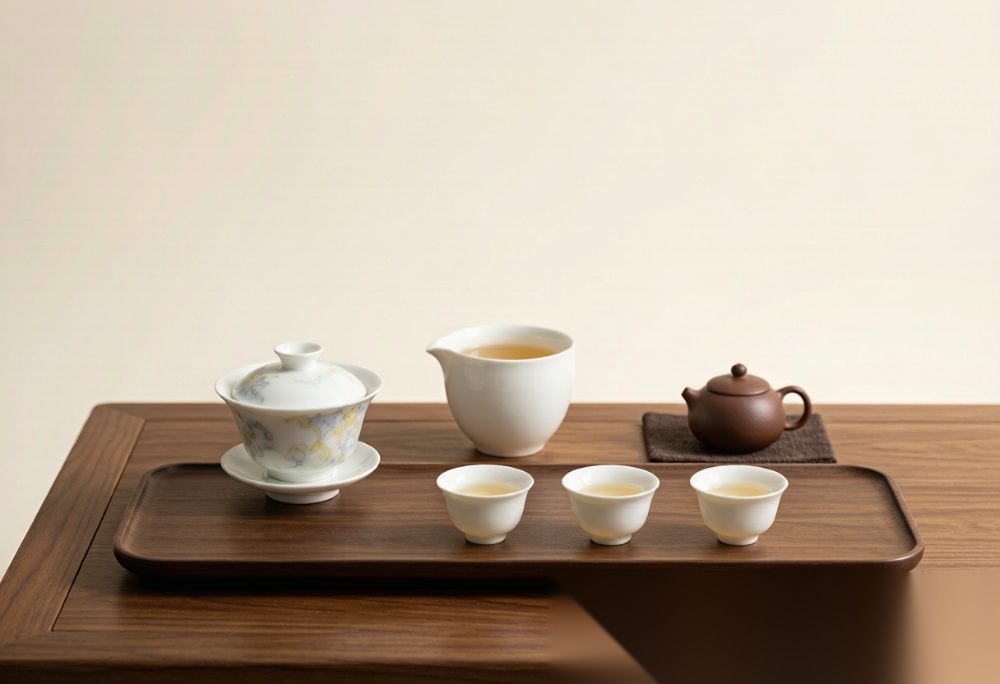
For more than a thousand years, two art forms have defined the refined taste of Chinese living: Chinese porcelain and the tea ceremony (gongfu cha). Long before porcelain left Chinese shores on the maritime Silk Road, it was already being shaped into cups, bowls, and ewers meant to be cradled in a scholar’s hand while fragrant steam curled upward. The vessel is not a passive container in Chinese tea culture — it is half the brew.
If you have ever tasted the same loose-leaf oolong, pu-erh, or bi Luo Chun from a paper cup versus a thin-walled Jingdezhen porcelain gaiwan, you already understand why ceramic choice matters. The clay, the glaze, the wall thickness, the lip — every dimension shifts aroma, mouthfeel, and color. In this guide, we walk through the cultural journey that ties Chinese porcelain, tea ware, and the ceremony itself into one continuous craft tradition.
1. Why Porcelain Is the Soul of Chinese Tea
Tea is a sensory art. The drinker tastes bitterness and sweetness, of course, but also watches the unfurling leaf, smells the wet leaf, hears the pour, and feels the warmth of the cup. Porcelain — the translucent, vitrified ceramic perfected in Jingdezhen during the Eastern Han dynasty — is uniquely suited to this multi-sensory experience.
1.1 White Porcelain Reveals the True Color of Liquor
High-fired Jingdezhen porcelain, with its bluish-white body (qingbai) or pure white body, acts like a neutral canvas. The pale gold of a well-steeped shou pu-erh, the apricot blush of a roasted Da Hong Pao oolong, the bright green of a young Long Jing — each is visible only against a white ceramic background. Glazed teapots in deep red, purple, or black absorb these tones and hide them. For connoisseurs who value visual evaluation, white porcelain is non-negotiable.
1.2 The Smooth Glaze Cleans the Palate Between Steeps
Gongfu cha is brewed in rapid, short steeps — sometimes six, eight, or ten infusions from the same leaves. A non-porous, vitrified glaze means the cup carries no lingering flavor from one steep to the next. The drinker’s palate stays calibrated, so they can detect subtle shifts in body, sweetness, and hui gan (returning sweetness) across steeps.
1.3 Thin Walls Transmit Heat Without Burning
A skilled porcelain smith can throw walls as thin as 1 millimeter. The cup warms in the hand and the rim stays cooler than the body, allowing the drinker to sip without scalding. This is why a properly made porcelain tasting cup (pin ming bei) feels alive in the hand — a small but meaningful detail in a long ceremony.
2. The Three Core Vessels: Gaiwan, Teapot, and Fairness Cup
Every gongfu tea setup rests on three porcelain pieces, often called the three friends of tea:
- Gaiwan (lidded bowl) — the all-in-one brewing vessel
- Teapot — the dedicated brewer for aged or rolled leaves
- Fairness cup (gong dao bei, or sea of fairness) — the pouring vessel that equalizes strength
2.1 The Gaiwan: Where Most Modern Tea Drinkers Begin
The gaiwan — literally “lid bowl” — is a three-piece vessel: a bowl, a lid, and a saucer. The drinker uses the lid to hold back leaves while pouring. Gaiwans of 100–150 ml are the standard for solo gongfu practice, while 200–300 ml versions serve small groups.
Jingdezhen white porcelain gaiwans are the most common starter choice for a reason: they show leaf color, they are affordable, and they work beautifully for almost every tea category. Collectors often own a dozen gaiwans in different sizes, colors, and motifs — a “thin-walled” blue-and-white set for daily oolong, a hand-painted famille-rose set for special guests, a single-color celadon set for green tea.
2.2 The Teapot: When Leaves Need a Private Room
For tightly rolled Tieguanyin, twisted Wuyi rock teas, or shou pu-erh that has been compressed into cakes, a teapot gives the leaves more room to unfurl. Most Chinese tea drinkers in southern Fujian or Guangdong own at least one Yixing zisha teapot — but in northern China, and increasingly worldwide, Jingdezhen porcelain teapots are the preferred daily brewer because they do not retain aroma from one tea type to the next.
2.3 The Fairness Cup: Why Every Host Uses One
Because loose leaves steep unevenly in a small vessel, the first pour is often weaker and the fifth is stronger. The fairness cup catches the entire brew, then redistributes it evenly into small drinking cups. Without it, a guest who pours first always gets a thin cup. With it, everyone shares the same flavor profile. The fairness cup is, in miniature, the moral argument for the whole ceremony.
3. Yixing Teapots: The One Exception to the Porcelain Rule
If porcelain dominates Chinese tea ware, Yixing zisha (purple sand) teapots are the one famous exception. Made in Dingshan, Jiangsu province since the Ming dynasty, Yixing pots are unglazed, porous, and made from a unique iron-rich clay.
3.1 Why Dedicated Tea Drinkers Own One
Yixing clay is slightly porous. With use, it absorbs trace oils from the leaves and gradually seasons to a specific tea type. A well-used Yixing pot for shou pu-erh will pour a noticeably rounder, deeper, more mellow cup than the same leaves brewed in porcelain. The pot is, in effect, a partner in the brewing.
3.2 The One-Tea Rule
Because of this seasoning, the cardinal rule of Yixing is one pot, one tea family. A pot seasoned for shou pu-erh will mute and confuse a light green tea. Serious collectors maintain a shelf of small Yixing pots — one for rock oolong, one for raw pu-erh, one for Dancong, and so on.
3.3 Porcelain vs Yixing: When to Use Each
| Use case | Recommended vessel | Why |
|---|---|---|
| Green tea, yellow tea, white tea | White porcelain gaiwan | Preserves delicate aroma; shows pale liquor color |
| Light oolong (Tieguanyin, Dancong) | Porcelain gaiwan or thin porcelain pot | Neutral glaze; allows repeated tasting comparison |
| Rock oolong (Da Hong Pao, Rou Gui) | Yixing zisha pot (dedicated) | Adds roundness; seasons with high-roast notes |
| Shou pu-erh (ripe) | Yixing zisha pot or porcelain | Porcelain for tasting; Yixing for daily drinking |
| Sheng pu-erh (raw, aged) | Porcelain gaiwan | Neutral vessel lets you taste aging, not the pot |
4. The Six Standard Teacup Types
Once tea is brewed, the choice of drinking cup changes the experience just as much. Most Chinese tea sets include a small selection of cup styles, each with a historical role.
- Pin ming bei (tasting cup) — tall, flared, narrow; used by connoisseurs to evaluate color and aroma in small sips.
- Wen xiang bei (smelling cup) — paired with a taller drinking cup; the tea is poured first into the smelling cup, the drinker inhales from it, then transfers the liquid to the mouth by inverting the two cups.
- Zhong bei (bell cup) — small inverted-bell shape, the most common gongfu drinking cup; pairs with a saucer.
- Ye ye wan (leaf-viewing bowl) — a wide, shallow bowl used for brewing whole-leaf green tea so the drinker can watch the leaves descend.
- Zhu sha bei (sand-red cup) — small and slightly flared, the everyday teacup for home drinking.
- Chrysanthemum cup — wide and low with a fluted edge, often used for chrysanthemum and other flower teas.
For a first set, a Jingdezhen porcelain gongfu tea set usually includes a 150 ml gaiwan, a fairness cup, and six small bell cups on saucers — everything needed for two to three guests.
5. Glaze, Form, and Cultural Meaning
Beyond function, the glaze and form of tea ware carry cultural meaning that has been refined for centuries.
5.1 Ge Ware and the Aesthetic of Imperfection
The Song dynasty Ge ware is famous for its crackled glaze — a network of fine lines that deepen with use. The aesthetic celebrates wabi (refined austerity) and the beauty of time. A crackled tea bowl, like a crackled tea table, improves with age.
5.2 Celadon: The Sea-Green of Long Jing
Longquan celadon, with its jade-like blue-green glaze, has been paired with green tea since the Southern Song dynasty. The cool tone of the glaze mirrors the fresh, vegetal quality of the leaf. A celadon gaiwan pouring a pale green Long Jing is one of the most photographed images in Chinese tea culture.
5.3 Blue and White Porcelain: The Global Standard
Blue and white (qinghua) porcelain, with cobalt-blue underglaze painting on a white body, became the global standard for Chinese export porcelain from the Yuan dynasty onward. A blue-and-white gaiwan is the most recognizable Chinese tea vessel in the world, and a sensible default for travelers and gift-givers.
5.4 Symbolism in Decoration
Decorative motifs on Chinese tea ware are rarely accidental. Pine, bamboo, and plum (song zhu mei) represent the three friends of winter — appropriate for a host’s enduring friendship. Lotus stands for purity; the shou character for longevity; bats (fu) for good fortune. Choosing a motif for your personal set is a small but real expression of the message you want to send to a guest.
6. How to Choose a First Set Without Overpaying
For readers new to Chinese tea, the right first set is a small, well-made Jingdezhen porcelain gongfu set, not an elaborate carved Yixing pot. Here is a short practical checklist.
- Buy white first. A white gaiwan and white cups let you see the tea. Decorative glazes come later.
- Hold the gaiwan in one hand. The lid should pivot smoothly; the bowl should feel light; the lip should be smooth against the finger.
- Tap the cup lightly. High-fired porcelain rings with a clear, sustained tone. A dull thud often means the body is too thick or under-fired.
- Check the saucers. A wobbling saucer is a sign of poor finishing. Good sets have level saucers that sit flat on the table.
- Skip mass-market Yixing. Real, single-clay, well-fired Yixing pots are an investment. A cheap “Yixing” pot is usually chemically tinted slip ware that will muddy the tea.
7. Caring for Your Tea Ware
Porcelain is forgiving, but a few habits will keep a set in good shape for decades.
- Rinse, don’t soap. Fragrance-free hot water is enough. Scented dish soap will linger and transfer to the next brew.
- Air-dry upside down. A draining rack for cups and gaiwans prevents water spots on the unglazed foot ring.
- Keep Yixing dry and dedicated. After rinsing a Yixing pot, leave the lid off for several hours so the inside dries completely. Never store it in a sealed cabinet while damp.
- Avoid thermal shock. Don’t pour boiling water into a cold cup straight from the fridge. A brief warm rinse prevents crazing on older glazes.
8. A Short History: From the Tang Tea Bowl to the Modern Tea Table
Tea in China began in the Shang and Zhou dynasties as a medicinal herb, but it was the Tang dynasty (618–907) that elevated it to a cultural institution. Lu Yu’s Classic of Tea codified brewing, leaf selection, and the role of the tea bowl. The Tang aesthetic favored a sky-blue Yue ware bowl that framed a frothy, whisked tea cake — the opposite of the clear, steeped liquor we drink today.
By the Song dynasty, the whisking ritual gave way to steeped leaf, and the tall Jian ware black bowl — with its iridescent “hare’s fur” and “oil spot” glazes — became the connoisseur’s choice. The Song also saw the first rise of Jingdezhen porcelain as a serious industry, producing the bluish-white qingbai ware that anticipated later white porcelain.
The Ming dynasty brought powdered tea to an end and ushered in the loose-leaf style we still use. The gaiwan, the Yixing teapot, and the modern gongfu setup all matured in the late Ming and early Qing. From the 17th century onward, European demand for Chinese tea fueled massive orders for blue-and-white porcelain — a process that shaped the very first global trade in tea ware.
9. Bringing It All Together: A Simple Daily Ritual
If you take only one practical idea from this guide, let it be this: a daily 10-minute tea ritual is enough to transform a routine.
- Warm a 150 ml Jingdezhen white porcelain gaiwan with hot water; discard the water.
- Add 5–7 grams of loose-leaf oolong or pu-erh.
- Steep for 10 seconds; pour into a fairness cup; divide into small bell cups.
- Smell the wet leaves, then the empty gaiwan — the residual aroma is a guide to the next steep.
- Steep again for 15 seconds, then 20, then 25, until the leaves are exhausted.
With practice, the same leaves yield a half-hour of small, evolving cups. The porcelain stays neutral, the hands stay warm, and the mind has a quiet place to land. This is the unbroken thread that runs from the Tang tea masters to a modern kitchen in Hangzhou, Berlin, or San Francisco.
10. Where to Explore Further
For collectors, the Jingdezhen ceramics market remains the deepest single source of porcelain tea ware in the world. Antique shops in Shanghai’s Dongtai Road and Beijing’s Liulichang also carry historical pieces, though condition and provenance matter. For daily drinking, a well-made modern Jingdezhen gongfu set is the most honest starting point — light, neutral, and built to last decades of daily use.
If you are building a personal set and would like to see how a master porcelain workshop selects, throws, glazes, and fires the pieces that end up on a tea table, we invite you to contact our workshop in Jingdezhen or browse our handmade porcelain tea sets. Each piece is made by a craftsman who has spent decades learning the single skill of throwing a perfect gaiwan — the same skill that has defined Chinese porcelain since the Song dynasty.
This article is part of our ongoing series on Chinese porcelain and tea culture. For a deeper look at the making process itself, see our guide on the complete Jingdezhen porcelain making process, and for the symbolic language painted on traditional pieces, see Chinese porcelain patterns decoded.
Discover more from Zhejiang Ceramics (Jingdezhen)
Subscribe to get the latest posts sent to your email.