
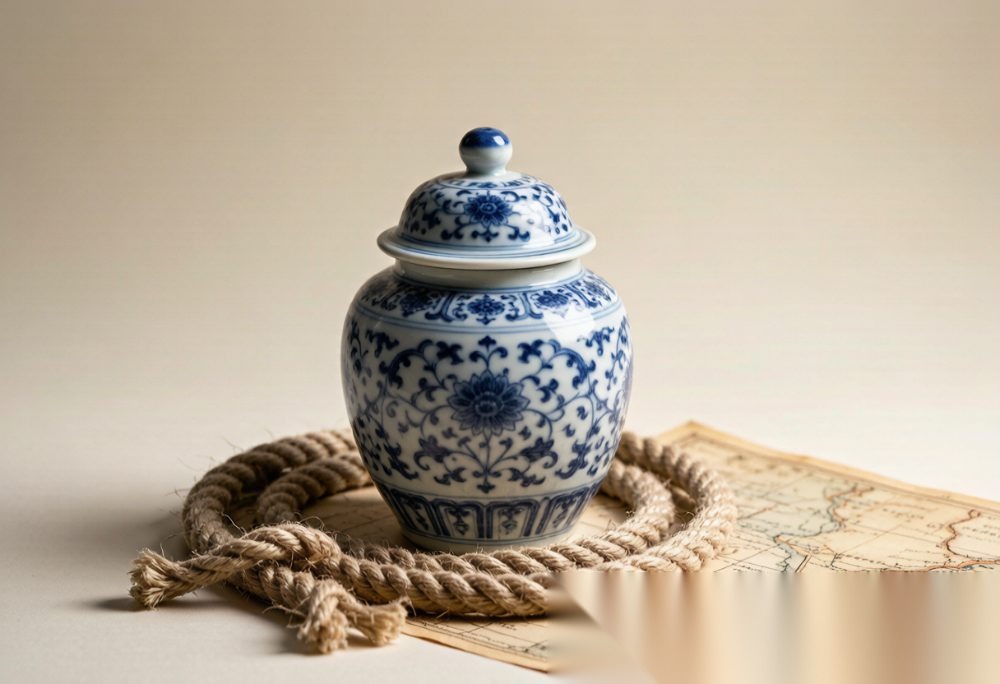
Few products in human history have traveled farther, crossed more cultures, and reshaped more economies than Jingdezhen porcelain. Long before the first container ship, before the first railroad, before the first European factory could even spell “kaolin,” Chinese porcelain was sailing the Maritime Silk Road — packed in straw, lashed to the decks of junks, dhows, and galleons, bound for every palace and port from Hormuz to Amsterdam. This is the story of how clay from one small town in Jiangxi province became the world’s first truly global luxury brand.
The Maritime Silk Road (海上丝绸之路, hǎi shàng sī chóu zhī lù) was never a single route but a shifting network of sea lanes connecting Chinese ports — Quanzhou, Guangzhou, Ningbo — to Southeast Asia, the Indian Ocean, the Persian Gulf, East Africa, and eventually Europe. From the 9th century onward, porcelain joined silk as the signature cargo. By the 17th century, porcelain had overtaken silk entirely in volume and value, becoming the dominant export of the Ming and Qing dynasties. The term “china” itself — lowercase, the word we still use for fine ceramic tableware — is a direct legacy of this trade.
1. The Beginnings: Porcelain on the Ancient Sea Routes (9th–13th Century)
The earliest recorded maritime export of Chinese ceramics dates to the Tang dynasty (618–907). The Belitung shipwreck, discovered off the coast of Indonesia in 1998, carried over 60,000 pieces of Tang ceramics — mostly Changsha stoneware bowls, but also a small number of early Xing ware white porcelain pieces. The ship was an Arab dhow, and its cargo was bound for the Abbasid caliphate. This single wreck proved that by the 9th century, Chinese ceramics were already being manufactured with Middle Eastern consumers in mind.
1.1 Why Porcelain Beat Silk at Sea
Silk was light and valuable — the perfect overland trade good. But at sea, where humidity, salt, and bilge water could ruin a bolt of silk in days, porcelain offered a surprising advantage: it was waterproof, heavy enough to serve as ship ballast, and stackable. A merchant could fill the bottom of his hull with porcelain and layer silk, spices, and tea on top. If the silk rotted, the porcelain survived. This practical packing logic turned ceramics into the bedrock cargo of every major Asian sea route.
1.2 The Song Dynasty: Quanzhou Becomes the World’s Busiest Port
By the Southern Song dynasty (1127–1279), the port of Quanzhou (Zayton, as Marco Polo called it) had become the largest harbor in the world — busier than Alexandria, busier than Venice. Merchants from Arabia, Persia, India, and Southeast Asia maintained permanent quarters in Quanzhou. They commissioned custom ceramic shapes — large platters for communal Middle Eastern dining, tall-necked ewers for washing, and kendis (ritual pouring vessels) for Southeast Asian ceremonies — all fired in Jingdezhen kilns and shipped down the Yangtze to the coast.
This period also saw the maturation of the qingbai (bluish-white) glaze — a translucent, pale-blue porcelain that became wildly popular across maritime Asia. Archaeological sites in Fustat (Old Cairo), Manda (Kenya), and Kollam (India) have all yielded Song-era qingbai sherds, marking the first wave of truly global Jingdezhen porcelain.
2. The Mongol Catalyst: Yuan Dynasty and the Birth of Blue-and-White
The Yuan dynasty (1271–1368) brought Mongol rule over the largest contiguous land empire in history. But it also brought something else: cobalt.
2.1 Persian Cobalt Meets Jingdezhen Clay
Mongol control of the Silk Road — both overland and maritime — opened direct trade between the Ilkhanate (Persian-ruled Iran) and Yuan China. Persian merchants in Quanzhou and Jingdezhen carried sacks of Samarra cobalt — a deep, vibrant blue mineral from the Zagros Mountains — and asked Jingdezhen potters to paint it under a transparent glaze onto white porcelain bodies. The result was blue-and-white porcelain (青花, qinghua), the single most influential ceramic innovation of the last millennium.
Before Yuan blue-and-white, Persian and Middle Eastern buyers had already decorated their local earthenware with cobalt designs. But local clays fired yellow or buff. The blinding white body of Jingdezhen porcelain — the result of kaolin (a pure white clay named after Gaoling Mountain near Jingdezhen) and petuntse (a feldspathic rock that vitrifies to glass) — produced a canvas that made cobalt blue sing. No potter outside China could replicate it for another 400 years.
2.2 The Topkapi and Ardebil Collections
The two greatest surviving collections of Yuan and early Ming blue-and-white porcelain are not in China. They are in the Topkapi Palace Museum in Istanbul (10,358 pieces) and the Ardebil Shrine in Iran (805 pieces). Both collections were assembled by royal patrons — Ottoman sultans and Safavid shahs — who valued Jingdezhen porcelain above gold and passed it down through imperial treasuries. These collections remain the world’s most important archives of early Chinese export porcelain, and they exist because the Maritime Silk Road made porcelain the currency of kings.
3. The European Madness: Porcelain Fever (16th–18th Century)
When Portuguese carracks first rounded the Cape of Good Hope and reached Guangzhou in 1513, they found something Europe had never seen: a thin-walled, translucent, resonant white material that held boiling water without cracking and could be painted with colors more vivid than any known glaze. Europe had no word for it — so they borrowed the Portuguese porcelana, from the cowrie-shell-like sheen the glaze produced.
3.1 The Portuguese: First Movers
The Portuguese established Macau in 1557 and built the first direct porcelain supply line from Jingdezhen to Lisbon. Early Portuguese commissions included the famous “carrack porcelain” — large platters and ewers decorated with the royal arms of Portugal, the Jesuit IHS monogram, or nautical motifs like ships and astrolabes. These pieces, made in Jingdezhen to Portuguese order, are the first known examples of custom-ordered Chinese export porcelain for a named European buyer.
3.2 The Dutch Golden Age and the VOC
The game changed in 1602 when the Dutch East India Company (Vereenigde Oostindische Compagnie, or VOC) was founded. Within a year, the VOC captured a Portuguese carrack, the São Tiago, and auctioned its cargo of porcelain in Amsterdam. The sale caused a sensation. Dutch merchants, who had never seen such quantities of fine Chinese ceramics, began placing massive standing orders.
Between 1602 and 1682, the VOC imported approximately 12 million pieces of Chinese porcelain into Europe — and that number counts only the official VOC records, not private trade or smuggling. The volume was so large that Jingdezhen had to expand its kiln capacity to keep up, and the term kraakporselein (after the Portuguese carracks that carried it) entered the Dutch language.
3.3 Kraak Porcelain: The First Mass-Produced Global Design
Kraak porcelain — named for the carracks that carried it — is arguably the world’s first globally mass-produced design. It featured a distinctive paneled border of alternating wide and narrow compartments, each filled with flowers, Buddhist emblems, or Daoist symbols, surrounding a central medallion of birds, deer, or landscapes. This modular, border-heavy layout influenced European ceramics for two centuries — you can see its echo in Delftware, Meissen, and even Victorian transfer-ware.
4. Five Iconic Shipwrecks That Rewrote History
Marine archaeology has given us the most vivid records of the Maritime Silk Road porcelain trade. Each shipwreck is a time capsule — a single moment when a merchant vessel, its cargo, and often its crew, went down together.
| Shipwreck | Date | Location | Cargo highlight | Significance |
|---|---|---|---|---|
| Belitung | c. 826 | Indonesia | 60,000+ Changsha bowls, earliest Xing white porcelain | First proof of mass ceramic export by sea; Arab dhow carrying Chinese goods |
| Intan | c. 930 | Java Sea | Thousands of Yue ware, Ding ware, and early Jingdezhen sherds | Shows the shift from stoneware to true porcelain in export cargo |
| Sinan | 1323 | Korea | 20,000+ pieces, mostly Longquan celadon | Largest known Yuan-era cargo; shows celadon dominance before blue-and-white |
| Vung Tau | c. 1690 | Vietnam | 48,000 pieces of Kangxi blue-and-white | Pure Jingdezhen export cargo; demonstrates scale of late 17th-century trade |
| Geldermalsen | 1752 | South China Sea | 150,000+ pieces, plus 125 gold bars | Also known as the “Nanking Cargo”; auctioned at Christie’s in 1986 for £10 million |
The Geldermalsen (or Nanking Cargo) sale is a landmark in its own right. When Christie’s auctioned the recovered porcelain in Amsterdam in 1986, prices ranged from modest to breathtaking — and the event single-handedly revived the global market for Chinese export porcelain. Collectors who had never cared about ceramics suddenly wanted a piece of the shipwreck story.
5. The Great Types of Export Porcelain
Not all porcelain that left China was the same. Over centuries, distinct categories of export ware emerged, each tailored to a different market segment.
5.1 Chinese Taste (Domestic Style)
Early exports — Tang through early Ming — were essentially Chinese domestic pieces repackaged for foreign sale. The shapes, motifs, and glazes were what Chinese buyers wanted; foreign merchants simply bought what was available. This is why the Belitung wreck carried Changsha bowls with Tang dynasty poetry inscribed on them — the potters were writing for a Chinese audience, not an Arab one.
5.2 Transitional/Mixed Style
By the late Ming, Jingdezhen potters had learned to blend Chinese and foreign aesthetics. A single platter might feature a classical Chinese landscape in the center but a border of Islamic geometric patterns. This “transitional” style peaked during the Wanli and Tianqi reigns, when the Ming court’s patronage declined and potters relied increasingly on export orders to survive.
5.3 Armorial Porcelain (Custom Commission)
From the late 17th century, European noble families, guilds, and trading companies sent drawings of their coats of arms to Jingdezhen, where potters reproduced them faithfully in underglaze blue or overglaze enamel. Armorial porcelain became the ultimate status symbol — a dinner service bearing one’s own crest, made on the other side of the planet by craftsmen who had never seen a European castle. Thousands of armorial services survive in museums and private collections, each a unique intersection of Chinese craftsmanship and European identity.
5.4 Canton Enamel (Guangzhou Overglaze)
In the 18th century, a shorter supply chain emerged: white Jingdezhen porcelain bodies were shipped in bulk to Guangzhou (Canton), where specialized workshops applied overglaze enamel painting to order. This allowed faster turnaround for custom designs and produced the vividly colored famille rose and famille verte palettes that dominated European markets in the Qianlong period. Canton enamel workshops were the first true “finishing houses” in global supply chain history — a model that modern manufacturing still follows.
6. How Porcelain Reshaped Global Culture
The impact of the Maritime Silk Road porcelain trade went far beyond commerce. It changed what people ate from, how they decorated their homes, and even how they thought about technology.
6.1 The Dining Table Revolution
Before Chinese porcelain arrived in Europe, most households ate from wood, pewter, or coarse earthenware. Pewter lent a metallic taste to acidic foods; wood absorbed odors and harbored bacteria; earthenware was heavy and fragile. Porcelain was light, impermeable, and tasteless — a revolution in hygiene as much as aesthetics. By the late 18th century, a middle-class Dutch or English household considered a set of Chinese (or Chinese-style) porcelain as essential as a dining table itself.
6.2 The European Quest to Crack the Secret
For nearly 300 years, European chemists, alchemists, and potters tried and failed to make true hard-paste porcelain. The secret was kaolin — a specific weathered feldspar clay — combined with petuntse and fired at temperatures above 1,280°C. European clays melted at those temperatures, collapsing into glassy puddles. Augustus the Strong, Elector of Saxony, imprisoned the alchemist Johann Friedrich Böttger and ordered him to find the formula. In 1708, Böttger succeeded — using kaolin from Colditz, Saxony — and the Meissen factory was born. European hard-paste porcelain was, in the most literal sense, the product of industrial espionage driven by obsession with Jingdezhen.
6.3 Chinoiserie: When the Whole Continent Dressed Chinese
By the mid-18th century, European demand had created an entire aesthetic movement: chinoiserie. Pagodas appeared in English gardens. French aristocrats built entire rooms paneled in lacquer and hung with Chinese wallpapers. Dutch painters incorporated blue-and-white porcelain into still-life compositions. The Willow Pattern — a pseudo-Chinese design invented by English engraver Thomas Minton around 1790 — became the most reproduced ceramic pattern in British history, printed on millions of plates and still in production today. This was cultural appropriation on a continental scale, all downstream from the Maritime Silk Road.
7. The Decline and the Legacy
The Maritime Silk Road porcelain trade peaked in the Qianlong reign (1735–1796) and declined thereafter for three reasons. First, Meissen, Sèvres, Wedgwood, and dozens of smaller European factories had mastered hard-paste porcelain by the late 18th century, reducing demand for expensive imports. Second, the Opium Wars (1839–1842, 1856–1860) disrupted Chinese production and trade routes. Third, the collapse of the Qing dynasty and the chaos of the early 20th century temporarily broke the chain of master-apprentice transmission in Jingdezhen itself.
And yet the legacy endures. The word “china” on every kitchen shelf. The blue-and-white color scheme on everything from Dutch tiles to Italian tablecloths. The global supply chain logic — raw materials from one continent, manufacturing in another, finishing in a third — that defines modern commerce. And the kilns of Jingdezhen, which still fire today, still using local kaolin, still producing porcelain that art collectors and tea drinkers on every continent recognize instantly as the real thing.
8. Bringing the Maritime Silk Road to Your Table
You do not need a shipwreck salvage or an auction budget to bring this history into your daily life. Here is a short, practical guide for anyone who wants to connect with the Maritime Silk Road tradition through real objects.
- Start with a blue-and-white piece. A single Jingdezhen blue-and-white cup, bowl, or vase carries the direct lineage of Yuan-dynasty innovation and VOC-era trade in its cobalt lines.
- Look for the kaolin difference. Hold the piece to the light. True Jingdezhen hard-paste porcelain is slightly translucent at the rim — a sign of high kaolin content and high-temperature firing above 1,280°C.
- Learn to read the motifs. A dragon means power, a lotus means purity, a phoenix means renewal — the same visual language that Persian and Dutch merchants learned to decode 400 years ago.
- Mix periods and styles. The beauty of export porcelain is its hybrid nature. A Song-style celadon bowl, a Ming-style blue-and-white plate, and a Qing-style famille rose vase live comfortably together on the same table — just as they did in a VOC merchant’s Amsterdam canal house.
- Visit the source. If travel is possible, the Jingdezhen Ceramics Museum, the Quanzhou Maritime Museum, and the ancient kiln sites at Hutian tell the full story. If not, the collections at the British Museum, the Rijksmuseum, and the Topkapi Palace bring the Maritime Silk Road to you.
If you are looking to own a piece of this thousand-year tradition — not an antique behind glass, but a functional, handcrafted piece that you can use every day — we invite you to explore our handmade Jingdezhen porcelain bowls, gongfu tea sets, and dinnerware. Every piece is made in Jingdezhen from local kaolin, glazed by hand, and fired at temperatures that the kiln masters of the Yuan dynasty would recognize. To ask about a specific piece or discuss a custom order, please contact our workshop — we answer every inquiry personally.
This article is part of our ongoing series on Jingdezhen porcelain history and culture. To learn what happens before the porcelain reaches a ship, see our guide on the complete Jingdezhen porcelain making process. To understand the symbolic language painted on the pieces that traveled these routes, read our guide to Chinese porcelain patterns decoded.
Discover more from Zhejiang Ceramics (Jingdezhen)
Subscribe to get the latest posts sent to your email.