
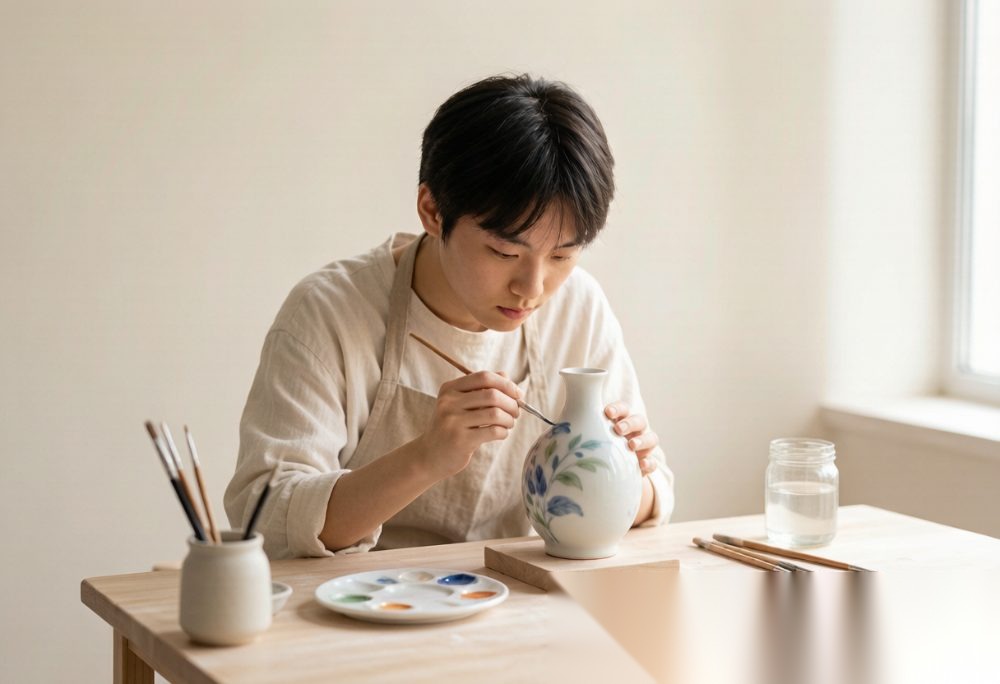
Walk into the old imperial kilns site of Jingdezhen on a quiet Tuesday morning and you will hear a sound the city has produced for over a thousand years — the rhythmic thump of a wooden paddle on clay, the hiss of glaze being poured, the low hum of electric kilns that have replaced the ancient dragon kilns of the Ming and Qing dynasties. What is different today is who is making the sound.
The new face of Jingdezhen porcelain is young, global, and entrepreneurial. In once-abandoned factory buildings, a generation of artisans in their twenties and thirties is reinventing Chinese ceramics — fusing Song dynasty aesthetics with Scandinavian minimalism, pairing hand-painted cobalt with 3D-printed components, selling directly to design studios in Berlin, Tokyo, and Brooklyn. Their work is changing both the look and the economics of Chinese porcelain.
In this guide, we introduce you to the new generation of Jingdezhen artisans — the family workshops, the design studios, the experimental makers — who are shaping what Chinese porcelain means in the 21st century. Whether you are a collector, a designer, a buyer, or simply a lover of beautiful objects, understanding these makers will help you see Chinese ceramics in a completely new light.
1. The Sanbao Art District: Where the Revolution Lives
Just six kilometers east of Jingdezhen’s old town, the village of Sanbao has quietly become the beating heart of China’s contemporary ceramics scene. In the 1990s, a few potters began renting cheap abandoned buildings here, drawn by the village’s natural clay deposits and the presence of traditional wood-fired kilns. By the 2010s, Sanbao had become a magnet for ceramic artists from across China and abroad.
Today, Sanbao is a small artistic village of about 40 studios, guesthouses, and small galleries. Walking its narrow lanes, you will see a Beijing-trained sculptor firing an installation piece, a Japanese ceramicist sharing technique with a local apprentice, and a French designer photographing tea bowls for a Paris boutique. The atmosphere is informal, collaborative, and fiercely international.
What makes Sanbao special
- Affordable infrastructure — old factory buildings rent for a fraction of city prices, and electric kilns, glaze rooms, and wheels are widely available.
- Knowledge sharing — unlike the secretive workshops of the imperial era, modern Sanbao artisans actively trade techniques, materials, and firing schedules.
- Direct-to-customer access — many studios have their own teahouses and small showrooms, allowing visitors to buy directly from the maker.
- International residency programs — Jingdezhen now hosts residencies for ceramicists from over 30 countries, creating a constant cross-pollination of ideas.
The result is a creative ecosystem that did not exist a generation ago — and it is producing some of the most exciting porcelain being made anywhere in the world.
2. Four Makers Redefining Jingdezhen Today
To understand the new generation, it helps to meet them. Here are four representative voices — each representing a different path into contemporary Chinese porcelain.
Studio 1: The Family Workshop Reinvention — He Yi Pottery
The He family has been making porcelain in Jingdezhen for six generations, since the late Qing dynasty. For most of that time, the workshop produced traditional blue-and-white tableware for the domestic market. But when He Yi, the current head of the family, returned from studying industrial design in Milan in 2014, he knew the business had to change.
“Our great-grandfathers made the same bowls for a hundred years,” He Yi says. “My father made the same bowls for forty years. I cannot do that.”
His reinvention: keep the family’s hand-painted cobalt technique and high-temperature reduction firing, but apply them to a new product line of minimalist tea sets designed in collaboration with a Shenzhen-based design firm. The pieces — clean white porcelain with a single hand-painted line — have been picked up by concept stores in Seoul, Tokyo, and Copenhagen, and the He family workshop now exports 60% of its production, up from less than 5% a decade ago.
He Yi’s lesson: tradition is not a museum. It is a toolkit.
Studio 2: The Cross-Disciplinary Designer — Lin Mu Ceramics
Lin Mu never trained as a potter. She studied architecture at Tongji University in Shanghai and worked for three years at a Shanghai design firm before burning out and moving to Jingdezhen “to do something with my hands.”
What she discovered was that architectural thinking could transform porcelain. Lin’s signature pieces — large porcelain lampshades, modular tile systems, and a series of bone-white porcelain acoustic panels — apply the spatial logic of architecture to clay. The lampshades, in particular, have become an internet sensation: they filter light through a thousand tiny hand-cut openings, casting intricate shadow patterns on the ceiling.
“Architecture is about how light and space work together,” Lin says. “Porcelain is one of the most beautiful light-transmitting materials on earth. Why was no one using it for that?”
Lin Mu represents a new kind of Jingdezhen artisan — one who brings skills from outside ceramics and asks questions the traditional workshops never thought to ask.
Studio 3: The Cooperative Model — Sanbao Young Potters Collective
Starting a porcelain studio in Jingdezhen is not cheap. A small electric kiln costs roughly 30,000 RMB ($4,200), a good wheel another 8,000 RMB, and the materials, glazes, and firing costs add up quickly. For young makers just out of art school, the capital barrier is real.
That is why, in 2018, eight young potters in Sanbao decided to pool resources. The Sanbao Young Potters Collective shares a single studio space, a set of three electric kilns, a glaze lab, and a small showroom. Each member works on their own art, but they share infrastructure and marketing costs, and they exhibit together at design fairs across China.
The collective has become a model for the next wave of young makers. By 2025, there were more than 15 similar cooperatives across Jingdezhen, and the model has spread to other Chinese craft cities like Yixing (teapots) and Dali (metalwork). It is, in many ways, a return to the ancient guild structure of pre-modern China — but adapted for a digital age.
Studio 4: The Heritage Revivalist — Fang Chen Studio
At the other end of the spectrum is Fang Chen, a 38-year-old artisan who has made it his life’s work to revive the imperial falangcai (enamel) porcelain of the Kangxi, Yongzheng, and Qianlong reigns — perhaps the most technically demanding form of Chinese ceramics ever developed.
Falangcai porcelain requires up to 30 individual firings, a palette of more than 20 mineral-based enamels, and the steady hand of a painter who has spent at least a decade mastering the technique. The imperial workshops employed hundreds of specialists, each responsible for one part of the process. Today, Fang Chen does it all himself.
“People say falangcai is a lost art,” Fang says. “It is not lost. It is just very, very hard.”
His studio produces perhaps 30 falangcai pieces a year, each one taking four to nine months to complete. They retail for anywhere from $8,000 to $80,000, and his client list includes private collectors in Hong Kong, Singapore, and the United States. Fang Chen is part of a small but growing movement of “heritage revivalist” artisans who believe that the future of Chinese porcelain lies not in abandoning tradition, but in mastering its most demanding forms.
3. New Materials, New Markets: How Today’s Artisans Work Differently
Beyond the individual studios, several structural changes are reshaping Jingdezhen’s craft economy.
3.1 The rise of electric and gas kilns
The traditional wood-fired dragon kiln, while beloved by purists, is increasingly rare in production use. A single firing consumes several tons of pine logs, takes three to seven days, and produces unpredictable results. Modern artisans have largely switched to electric kilns (precise, controllable, ideal for tableware) or gas reduction kilns (which can mimic the look of traditional wood firing with less waste). The result is a more sustainable, more consistent industry — though it has cost Jingdezhen some of its romance.
3.2 Digital tools and global design platforms
Today’s young artisans use 3D printers to prototype forms, Photoshop to design patterns, Instagram and Xiaohongshu (Little Red Book) to find customers, and Shopify to take international orders. A buyer in Brooklyn can commission a custom tea set from a Jingdezhen studio, see the 3D model online, and receive the finished piece by express courier within a month. The barriers between the maker and the global market have collapsed.
3.3 Direct-to-consumer (D2C) and the “slow craft” economy
Chinese consumers — particularly younger ones — are increasingly willing to pay a premium for handmade, locally produced craft goods. A hand-thrown Jingdezhen tea bowl that might have wholesaled for $8 a decade ago now sells direct-to-consumer for $40 to $80. The new generation of artisans has built small but profitable businesses by cutting out wholesalers and selling directly through social commerce platforms, weekend craft markets, and small studio showrooms.
3.4 Sustainability and material innovation
Concerned by the environmental impact of traditional production, several new studios are experimenting with recycled clay bodies, lead-free glazes, and biomass-fired kilns. The results are sometimes less consistent than traditional methods, but they are pointing the way toward a more sustainable future for Chinese ceramics.
4. The Old Masters Are Still Here
It would be wrong to suggest that Jingdezhen’s new generation has displaced its traditional makers. The city still has thousands of veteran artisans — many in their sixties and seventies — who produce the high-quality blue-and-white, celadon, and famille-rose porcelain that has made Jingdezhen famous worldwide.
What has changed is the relationship between the old masters and the young artisans. Increasingly, they collaborate. A 70-year-old master might fire a young designer’s prototype in his private kiln; a young artisan might digitize a master’s pattern library and license it to international buyers. The “old” and the “new” are no longer in opposition — they are forming a creative ecosystem that is, in many ways, the most vibrant in the world.
5. How to Buy From and Support the New Generation
If you are interested in collecting or commissioning from the new Jingdezhen artisans, here are a few practical tips.
5.1 Visit in person
There is no better way to understand the new Jingdezhen scene than to visit. The Sanbao art district, the Taoxichuan ceramic art avenue (a former factory site converted into a cultural zone), and the Saturday morning craft market at the old imperial kiln site are all essential stops. Plan at least three to four days; you will not see everything in one.
5.2 Buy direct from the studio
Buying from a studio’s small showroom cuts out the middleman and means more of your money reaches the artisan. Most studios are happy to ship internationally and can even customize patterns, glazes, and forms.
5.3 Look for collaboration, not just commerce
Many of the most interesting young artisans are open to creative collaboration — whether you are a designer, a hotel buyer, a wedding gift curator, or a museum gift shop. Reach out, share your vision, and ask what is possible. The most rewarding pieces are often the ones that come from a real conversation between maker and buyer.
5.4 Be patient with lead times
Unlike mass-produced ceramics from Chinese factories, a hand-made piece from a Jingdezhen studio can take anywhere from two weeks (for a simple tea bowl) to nine months (for a complex falangcai piece). Plan ahead.
6. The Future of Jingdezhen Porcelain
For most of the last century, Jingdezhen’s porcelain industry was dominated by state-owned factories producing export-grade tableware by the container load. Those factories are mostly gone now, and the city is still figuring out what comes next.
What is emerging is something genuinely new — a craft city that is simultaneously ancient and modern, traditional and experimental, local and global. The artisans of Sanbao and Taoxichuan, the family workshops, the heritage revivalists, the cross-disciplinary designers, the young potter cooperatives: together, they are writing a new chapter in a craft story that is already more than a thousand years old.
That chapter is being written right now, in studio after studio across the city, one fired piece at a time.
7. Frequently Asked Questions
7.1 Is Jingdezhen porcelain still worth buying today?
Absolutely. Jingdezhen remains the world’s premier city for high-quality porcelain, and the new generation of artisans is producing some of the most innovative work in the field. Whether you want a traditional blue-and-white piece or a cutting-edge contemporary design, you can find it in Jingdezhen.
7.2 How can I tell if a piece is from a real Jingdezhen artisan?
Look for a studio mark or signature on the base, ask for documentation of the firing process, and buy directly from the studio or from a reputable gallery. Pieces from cooperatives like the Sanbao Young Potters Collective will often have a small stamped logo.
7.3 What is the price range for contemporary Jingdezhen porcelain?
A simple hand-thrown tea bowl from a young artisan starts at around $20 to $40. A collaborative piece with a design firm can run $200 to $1,000. A heritage falangcai piece from a master like Fang Chen can cost $8,000 to $80,000 or more.
7.4 Can I visit Jingdezhen and tour studios?
Yes. Jingdezhen is well connected by high-speed rail to Shanghai, Hangzhou, and Nanchang, and most studios welcome visitors by appointment. The Taoxichuan ceramic art avenue has weekend markets, exhibitions, and small open studios that require no appointment at all.
Conclusion: A Living Tradition
Chinese porcelain is not a relic. It is a living, evolving craft, and the new generation of Jingdezhen artisans is proving that every single day. Whether you are buying your first piece or your hundredth, supporting these makers means supporting one of the great craft traditions of human history — and helping it write its next thousand years.
Ready to bring home a piece of contemporary Jingdezhen porcelain? Browse our curated collection of hand-made pieces from the artisans featured in this guide, or contact us for custom commissions and wholesale inquiries.
Discover more from Zhejiang Ceramics (Jingdezhen)
Subscribe to get the latest posts sent to your email.