
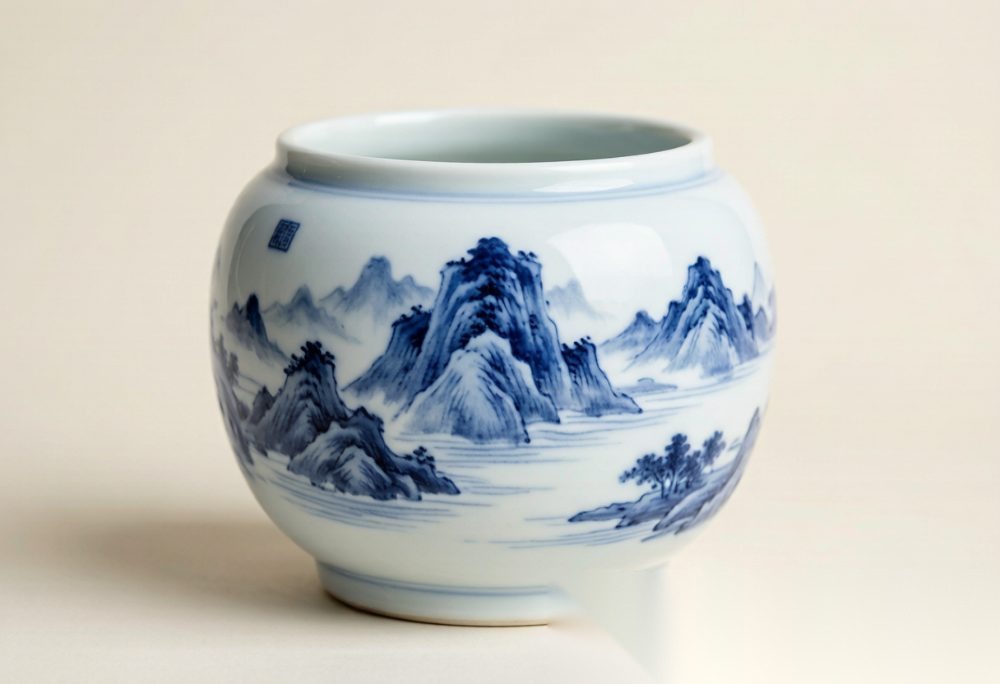
For more than a thousand years, Chinese painters have sought to capture the spirit of mountains and rivers on silk, paper, and — most unforgettably of all — porcelain. A great landscape painting on Jingdezhen porcelain is not a decoration applied to a vessel. It is a complete work of art in its own right, in which the brushwork, the glaze, the form of the piece, and the way light plays on its surface all conspire to evoke the layered rhythms of a Chinese landscape.
This is the art of shanshui hua ci (山水画瓷) — landscape painting on porcelain — one of the most refined and least understood branches of Jingdezhen’s craft tradition. In this guide, we trace its history from the Song dynasty to today, decode the techniques that make it possible, introduce the modern masters keeping the tradition alive, and offer practical advice for collectors and buyers.
1. Why Porcelain Is the Perfect Canvas for Mountains
Chinese landscape painting, or shanshui (literally “mountain-water”), is one of the oldest and most distinctive art forms in East Asia. The genre emerged in the Five Dynasties period (10th century), matured in the Song dynasty (960–1279), and reached its golden age in the Yuan and Ming dynasties. By the time porcelain from Jingdezhen became the imperial standard in the Yuan, painters were already looking for ways to translate shanshui’s mountain ridges, mist, and waterfalls onto curved ceramic surfaces.
Why porcelain works so well for landscape painting comes down to three unique properties:
- A luminous white ground. The cool, slightly bluish white of high-fired Jingdezhen porcelain acts like the white reserve of a Song dynasty silk scroll, allowing the brush to lay down clean, jewel-like strokes without color contamination.
- A surface that holds ink. The vitreous, glassy surface of well-fired porcelain allows cobalt oxide (for blue-and-white) and enamel pigments (for famille-rose and famille-verte) to fuse permanently with the glaze during firing, producing images that do not fade, chip, or wear.
- Three-dimensional form. Unlike a flat scroll, a porcelain vase is a curved, sculptural object. A landscape painted on its surface must respond to the form — the mountains rise and fall with the shoulder of the vase, rivers flow with the foot ring, mist gathers in the neck. The result is a landscape that the viewer experiences from multiple angles, almost as if walking through it.
Master porcelain painters of the past used these properties to create images that no scroll could match: panoramic landscapes that wrap continuously around a vessel, with brushwork that changes scale and intensity as the eye moves up the form.
2. A Brief History of Landscape Painting on Porcelain
The story of landscape painting on Jingdezhen porcelain is a story of slow refinement, sudden breakthroughs, and quiet revivals.
2.1 The Yuan dynasty (1271–1368): the first blue-and-white landscapes
The earliest surviving blue-and-white porcelain from Jingdezhen dates to the Yuan dynasty. Most early Yuan pieces are decorated with dense floral scrolls, dragons, or geometric patterns, but a small number feature landscape vignettes — typically a fisherman on a raft, a scholar in a pavilion, or a row of distant mountains rendered in heavy cobalt washes. These early landscapes are simple and schematic, but they establish the basic vocabulary that later painters would refine over centuries.
2.2 The Ming dynasty (1368–1644): the golden age of brushwork
Landscape painting on porcelain reached its first true maturity in the Ming dynasty, particularly during the reigns of the Chenghua (1465–1487) and Wanli (1573–1620) emperors. Chenghua-era porcelain is famous for its refined, almost calligraphic brushwork: cobalt outlines that are crisp but never mechanical, shading that suggests both distance and atmosphere, and small figural accents (a fisherman, a poet) that animate the landscape without overwhelming it.
By the Wanli period, the landscape vocabulary had expanded enormously. Mountains rose in tiered silhouettes, rivers curled around distant shores, and small pavilions perched on impossible cliffs. The famous wisteria vases of this period — large meiping forms painted with trailing wisteria blossoms over an underglaze landscape — are considered among the highest achievements of Chinese porcelain painting.
2.3 The Qing dynasty (1644–1911): imperial landscapes and the famille-rose revolution
Under the Kangxi, Yongzheng, and Qianlong emperors (1662–1795), Jingdezhen’s imperial kilns produced landscape paintings on porcelain of extraordinary technical sophistication. The introduction of famille-rose enamels from Europe (via Jesuit missionaries at court) opened up a new palette of soft pinks, yellows, and opalescent whites that perfectly mimicked the atmospheric perspective of Song and Yuan scroll painting.
Qing imperial landscapes often copied famous scroll paintings directly onto porcelain. A Qianlong-era vase might feature a faithful reproduction of a section of Guo Xi’s Early Spring (1072), a landscape so revered it had been copied by court painters for centuries. These porcelain “copies” are not slavish reproductions; they are translations, in which the painter has reinterpreted the brushwork for the curved surface and adjusted the composition to fit the form of the vessel.
2.4 The 20th and 21st centuries: revival and reinvention
The fall of the Qing dynasty in 1911 ended the imperial kilns, but landscape painting on porcelain continued in the private workshops of Jingdezhen. In the Republican period (1912–1949), painters like Wang Bu and Tong Yiquan developed a distinctive new style that combined traditional brushwork with the lighter, more atmospheric color palette of modern Chinese painting.
Since the 2000s, a new generation of porcelain landscape painters has emerged in Jingdezhen — many of them trained at the Jingdezhen Ceramic University and the Jingdezhen Ceramic Institute — who are producing contemporary work of remarkable quality. Some remain faithful to the traditional palette and brushwork; others experiment with abstract ink-wash effects, with three-dimensional carved landscapes, and with photographic realism. We will meet several of them later in this article.
3. The Three Essential Techniques
Landscape painting on porcelain is not a single technique but a family of related techniques, each with its own materials, firing schedules, and visual character. Understanding the differences will help you appreciate the work on display in any museum or antique shop.
3.1 Underglaze blue (qinghua, 青花)
The oldest and most demanding technique, underglaze blue uses cobalt oxide pigment painted directly onto the unfired porcelain body. The piece is then dipped in clear glaze and fired at a high temperature (around 1300°C). The cobalt fuses with the glaze, producing a deep, slightly translucent blue that is integral to the body of the porcelain — it cannot wear off.
Ming and Qing dynasty underglaze blue landscapes are the benchmark of the art form. A great master painter could produce an astonishing range of tones from a single pigment, from the deep, almost black blue of distant mountains to the pale, silvery blue of mist over water. The technique is unforgiving: a single slip of the brush cannot be corrected, and the high-temperature firing can blur fine lines if the painter’s hand is not perfectly steady.
3.2 Famille-rose enamels (fencai, 粉彩)
Introduced from Europe in the early 18th century, famille-rose enamels use a lead-borosilicate glass flux colored with colloidal gold (for pink), arsenic (for white), and various mineral oxides. The enamels are painted onto the already-fired glaze surface and then refired at a lower temperature (around 800°C). The resulting colors are softer and more varied than underglaze blue, but they sit on top of the glaze rather than being fused with it, making them slightly more vulnerable to wear.
Famille-rose landscapes are particularly prized for their ability to capture atmospheric effects. A famille-rose painter can layer pale yellow over pale green to suggest the warm light of late afternoon; soften edges with a tinted white to suggest mist; use the famous “famille-rose pink” to suggest the glow of sunset on distant peaks. The effect is closer to Song dynasty silk painting than to ink-wash scroll painting.
3.3 Ink-wash porcelain (shuimo ci, 水墨瓷)
The most modern technique, ink-wash porcelain uses special black or dark-grey pigments to mimic the look of Chinese ink painting (shuimo hua). Often combined with pale underglaze blue or with carved relief, ink-wash porcelain is the dominant style of contemporary Jingdezhen landscape painting.
Ink-wash porcelain painters work with brushes of different sizes and softness, controlling the amount of pigment and water to produce effects ranging from the dry, textured “broken ink” of a craggy cliff to the wet, atmospheric “flying white” of a waterfall. The technique requires the painter to be simultaneously a ceramicist, a calligrapher, and a landscape painter — a very rare combination of skills.
4. The Anatomy of a Porcelain Landscape
If you stand in front of a great landscape vase, your eye will move in a specific way. Master porcelain painters compose their landscapes to guide the viewer’s gaze in a particular sequence — typically from the foot of the vessel (the foreground) upward through the middle to the neck (the distant background), creating an illusion of depth on a curved surface.
The conventional layers of a porcelain landscape, from bottom to top, are:
- Water and foreground rocks — usually painted at the foot of the vessel, with bold brushwork and dark pigment. The water often has small fish, ducks, or lotus leaves for visual interest.
- Trees, pavilions, and human figures — the middle ground, painted at the widest part of the vessel. Trees are often rendered with distinctive dotted or stippled foliage; pavilions are tiny but meticulously detailed; human figures (a scholar, a fisherman, a woodcutter) are smaller than a fingernail but instantly recognizable.
- Distant mountains and mist — the upper register, painted in pale washes that suggest distance and atmosphere. The mist is achieved by leaving areas of white porcelain unpainted, so the white of the body itself becomes part of the composition.
- Sky and clouds — the neck of the vessel, often left largely white to suggest open sky, with a few calligraphic clouds or a single distant peak.
This bottom-to-top, dark-to-light progression creates a sense of recession and depth. The painter is essentially asking the viewer to climb the mountain as their eye travels up the vessel — a remarkably subtle effect, and one of the things that distinguishes great landscape porcelain from ordinary decoration.
5. Four Modern Masters of Jingdezhen Landscape Porcelain
Jingdezhen today is home to a small but extraordinary community of porcelain landscape painters. Here are four whose work represents the range of contemporary practice.
5.1 The Traditionalist: Master Zhuang Wenxian
Now in his seventies, Zhuang Wenxian is widely considered the finest living practitioner of classical blue-and-white landscape porcelain. Trained in the imperial-kiln tradition of the 1950s, he still paints in the slow, deliberate style of the Kangxi era, completing perhaps six large vases a year. His pieces are collected by museums in Beijing, Taipei, and London, and a single Zhuang landscape vase can fetch six-figure sums at auction.
Zhuang’s particular gift is for trees. Where most porcelain painters render foliage as abstract dots, Zhuang paints individual leaves with a few sure strokes of the brush — the trees on his mountains are recognizably pines, willows, or cypresses, even when rendered in monochrome cobalt. He has trained only a handful of students, and is said to be particular about who he accepts.
5.2 The Innovator: Yang Fei’s Cobalt-and-Gold Landscapes
Forty-two-year-old Yang Fei trained as a painter at the China Academy of Art in Hangzhou before moving to Jingdezhen in 2010. His signature technique combines traditional underglaze blue with overglaze gold enamel, producing landscapes in which distant mountains glow as if lit by late-afternoon sun. The effect is entirely new — there is no precedent for it in the Qing imperial kilns — and has been widely imitated.
Yang’s work is in the collections of the V&A Museum in London and the Metropolitan Museum of Art in New York, and he has exhibited at design fairs in Milan, Paris, and Tokyo. He runs a small studio in Sanbao with three assistants and accepts commissions from collectors and interior designers.
5.3 The Sculptor-Painter: Lin Jianhua’s Carved Landscapes
Lin Jianhua is a third-generation Jingdezhen artisan whose work blurs the line between painting and sculpture. After painting a landscape in underglaze blue, Lin uses fine carving tools to cut away parts of the porcelain body, creating a low-relief effect in which the mountains and trees physically emerge from the surface of the vase. The carved areas are then filled with a darker glaze, producing a subtle shadow effect that no purely painted landscape can achieve.
Lin’s work is laborious and slow — a single large carved-landscape vase can take six months to complete — but the result is unlike anything else in contemporary ceramics. His pieces are particularly popular with architectural firms and luxury hotel designers, who use them as statement pieces in lobbies and executive suites.
5.4 The Young Realist: Chen Yuxi’s Atmospheric Vases
At thirty-one, Chen Yuxi is the youngest of the four and the most stylistically adventurous. Chen paints landscapes that look almost like photographs at first glance — soft-focus mountain ranges fading into mist, single trees bending in a strong wind, reflections on still water. The illusion is achieved through a painstaking layering technique in which Chen applies up to a dozen thin coats of pale pigment, each fired separately, to build up the atmospheric depth.
Chen’s work has been controversial among traditionalists (some critics call it “too photographic, not painterly enough”), but it has found a strong market among younger collectors and design professionals. He sells directly through his Instagram account and ships to clients in twenty countries.
6. How to Read a Landscape Vase: A Buyer’s Quick Guide
If you are considering buying a landscape vase — whether antique or modern, museum-quality or simply decorative — there are a few things to look for.
6.1 Check the brushwork up close
Brushwork is the soul of porcelain landscape painting. Hold the piece to the light and look closely at the strokes. Good brushwork should look confident and varied — different pressures, different directions, different densities of pigment within a single stroke. Machine-printed lines, by contrast, look mechanical and uniform.
6.2 Look at the composition
A well-composed porcelain landscape should have a clear focal point (often a pavilion, a tree, or a figure), a clear sense of depth, and a sense of visual rhythm as the eye moves around the vessel. Avoid pieces where the landscape seems to be evenly distributed without hierarchy, or where the brushwork is too dense to “breathe.”
6.3 Examine the white space
Master porcelain painters use unpainted white porcelain as a positive design element. A great landscape vase will have intentional areas of white — for sky, mist, water, or empty space — that are as carefully placed as the painted areas. Pieces that are painted “wall to wall” with no breathing room are usually the work of lesser hands.
6.4 Consider the form and the painting together
The form of a vessel should always feel in dialogue with the landscape painted on it. A tall, slender meiping calls for vertical compositions (tall mountains, tall trees); a round, bulbous yuhuchunping is better suited to panoramic views. When the form and the painting clash, the result is uncomfortable to look at, no matter how technically good the brushwork.
6.5 Buy what moves you
Most importantly, buy a landscape vase because the landscape moves you. The technical criteria above are useful, but they are no substitute for the simple experience of looking at a piece of porcelain and being transported — for a moment — to the mountains, rivers, and mist of a Chinese landscape.
7. Frequently Asked Questions
7.1 What is the most valuable form of porcelain landscape painting?
Underglaze blue landscapes from the Chenghua and Wanli reigns of the Ming dynasty, and famille-rose landscapes from the Kangxi, Yongzheng, and Qianlong reigns of the Qing dynasty, are the most valuable. Genuine examples of these appear at major auction houses (Christie’s, Sotheby’s, Bonhams) and regularly sell for hundreds of thousands to millions of US dollars. Always buy from a reputable dealer with documented provenance.
7.2 Is modern Jingdezhen porcelain landscape painting a good investment?
Modern work by established masters like Zhuang Wenxian or Yang Fei has been steadily appreciating over the past decade, and the broader market for contemporary Chinese craft has been growing. However, as with any art, buy for love first and investment second. The market is less liquid than the market for antique porcelain, so do not expect to resell quickly.
7.3 How do I care for a porcelain landscape vase?
Handle it with clean hands, never put heavy pieces on unstable shelves, and avoid placing landscape vases in direct sunlight (which can fade famille-rose enamels over time). For cleaning, use a soft, dry brush to remove dust; never use water, soap, or chemical cleaners on painted porcelain. For valuable pieces, consider professional conservation every ten years.
7.4 Can porcelain landscape paintings be customized?
Yes. Most Jingdezhen studios accept commissions for custom landscapes — for example, a particular mountain from your home region, a scene from a favorite poem, or a family story rendered in landscape form. Lead times range from two to twelve months depending on the artist and complexity. This is one of the most rewarding ways to own a piece of porcelain landscape art.
Conclusion: A Landscape You Can Hold in Your Hands
Chinese landscape painting has always been about more than the visible world. It is a meditation on the relationship between human beings and nature, between the present moment and the eternal flow of mountains and rivers. To translate that onto porcelain — to wrap a continuous landscape around a curved vessel and fire it permanently into the glaze — is one of the great technical and artistic achievements of Chinese craft.
Whether you are an experienced collector, a first-time buyer, or simply a lover of beautiful objects, landscape porcelain offers something rare: a piece of art that holds an entire world in your hands.
Ready to bring a porcelain landscape into your home? Browse our curated collection of hand-painted landscape vases, tea bowls, and panels from the modern masters featured in this guide, or contact us to discuss a custom commission inspired by your favorite mountain, river, or poem.
Discover more from Zhejiang Ceramics (Jingdezhen)
Subscribe to get the latest posts sent to your email.