
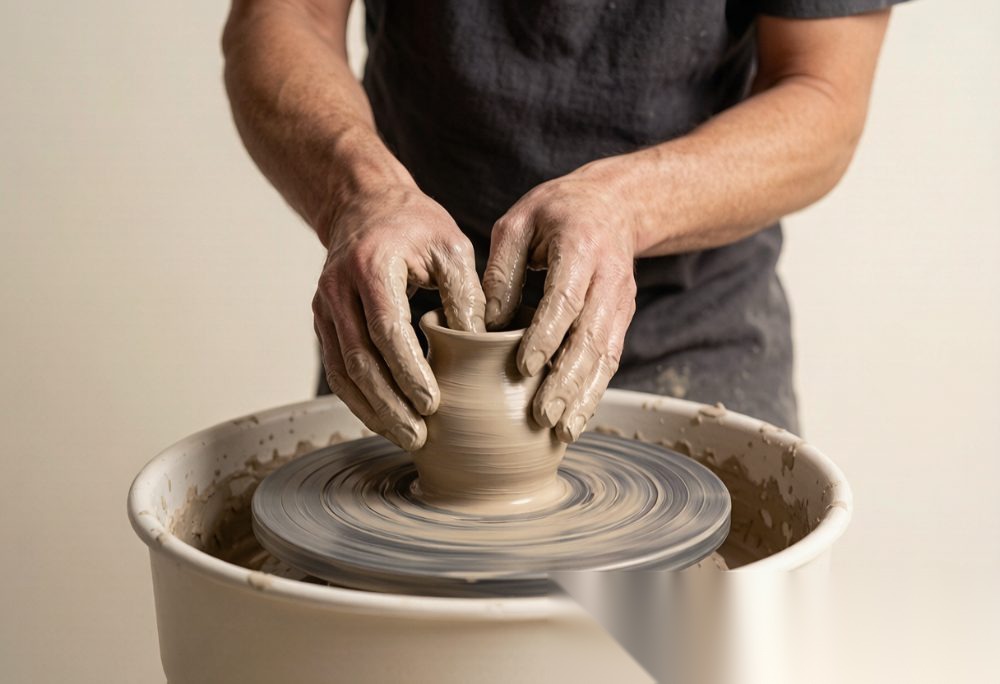
Behind every piece of Jingdezhen porcelain lies a journey that spans weeks, sometimes months, from raw earth to luminous art. The process has been perfected over more than a millennium, with each generation of artisans adding refinements while preserving the essential techniques that make Jingdezhen porcelain unlike any other ceramic in the world. Whether you are a collector, an enthusiast, or simply curious about how your favorite teacup came to be, understanding this process will transform the way you see — and appreciate — every piece.
Stage 1: Sourcing and Preparing the Raw Materials
Great porcelain begins with great clay. Jingdezhen’s geographic advantage lies in its access to two essential materials: kaolin (高岭土) and petuntse (白墩子, porcelain stone). The name “kaolin” itself comes from Gaoling (高岭), a mountain near Jingdezhen where the finest clay was historically mined.
Kaolin — The Skeleton
Kaolin provides the structural framework of porcelain. It is a white, fine-grained clay rich in the mineral kaolinite (Al₂Si₂O₅(OH)₄). Pure kaolin is plastic enough to shape but refractory — meaning it can withstand the extreme temperatures required for porcelain firing without deforming.
Petuntse — The Glass-Former
While kaolin gives porcelain its shape and heat resistance, petuntse (also called china stone) provides the glassy, translucent quality that distinguishes true porcelain from stoneware. Petuntse contains feldspar and quartz, which melt during firing and fill the spaces between kaolin particles, creating that characteristic semi-transparent body.
The Jingdezhen formula: Traditional Jingdezhen porcelain typically uses a ratio of roughly 60% petuntse to 40% kaolin — a balance that has been empirically optimized over centuries to produce maximum translucency without sacrificing structural integrity.
Material Preparation
Raw materials do not go directly from mine to wheel. They undergo extensive processing:
- Weathering: Clay is left outdoors for months or even years, exposed to rain, frost, and sun. This natural process breaks down coarse particles and improves plasticity.
- Washing and levigation: The clay is mixed with water and allowed to settle. Coarser particles sink first; the finest particles remain suspended and are decanted off, producing an exceptionally smooth body.
- Aging: The refined clay is stored in cellars, sometimes for years. During aging, bacterial action and continued chemical breakdown make the clay more workable and reduce the risk of cracking during drying and firing.
- Kneading (揉泥): Before shaping, the clay is hand-kneaded for extended periods to remove air bubbles and ensure uniform consistency. Trapped air is the enemy — it expands in the kiln and causes catastrophic explosions.
Stage 2: Shaping — Where Clay Becomes Form
Jingdezhen artisans employ multiple shaping techniques depending on the form, size, and intended use of the piece.
Wheel Throwing (拉坯)
The potter’s wheel remains the heart of Jingdezhen’s shaping tradition. A skilled thrower can produce remarkably uniform pieces at speed — a necessity for the large-scale production that made Jingdezhen famous. The key is consistent wall thickness, which ensures even drying and firing.
What to look for: Wheel-thrown pieces often show subtle spiral lines on the interior — not a flaw, but evidence of authentic hand production. Machine-molded pieces lack these telltale traces.
Molding (印坯 and 注浆)
For pieces with complex shapes — figurines, handles, relief decoration — plaster molds are used. There are two approaches:
- Press molding (印坯): Clay slabs are pressed into or over a mold. This traditional method is used for symmetrical pieces like bowls and plates that need to match precisely.
- Slip casting (注浆): Liquid clay slurry (slip) is poured into a plaster mold. The plaster absorbs water from the slip, depositing a layer of solid clay against the mold walls. Excess slip is poured out, leaving a hollow form. This is the standard method for complex shapes like teapots and figurines.
Trimming and Finishing (利坯)
After initial shaping, pieces are set aside until they reach “leather-hard” consistency — firm enough to handle but still slightly damp. At this stage, the trimmer (利坯师傅) mounts the piece back on the wheel and uses sharp steel tools to pare away excess clay, refining the profile and thinning the walls to their final gauge.
Trimming is where Jingdezhen’s porcelain achieves its legendary thinness. Master trimmers can produce walls as thin as 1-2 millimeters — translucent when held to light, yet strong enough to survive the rigors of kiln firing and daily use.
Stage 3: Bisque Firing (素烧)
Before glazing, shaped pieces undergo an initial firing at approximately 800-900°C. This bisque firing (素烧) serves several critical purposes:
- It drives off remaining physical water and chemically bound water
- It hardens the piece enough to handle without deformation
- It makes the body porous enough to absorb glaze suspension evenly
- It reveals hidden flaws — cracks, air pockets, weak spots — before the more expensive glaze firing
Pieces that fail bisque inspection are discarded. In Jingdezhen’s workshops, a 10-15% loss rate at this stage is considered normal and even healthy — it means only sound pieces proceed to the more resource-intensive phases.
Stage 4: Glazing — The Alchemy of Surface
Glaze is to porcelain what varnish is to a violin — not merely decorative, but transformative. A good glaze enhances the body’s natural translucency, provides a hygienic and durable surface, and contributes its own aesthetic dimension.
Glaze Composition
Jingdezhen glazes are primarily composed of:
| Component | Role | Typical Source |
|---|---|---|
| Silica (SiO₂) | Glass former | Quartz, petuntse |
| Alumina (Al₂O₃) | Stabilizer (prevents running) | Kaolin |
| Flux (K₂O, Na₂O, CaO) | Melting agent | Feldspar, wood ash, limestone |
| Colorants | Color (varies by glaze type) | Cobalt, iron, copper, manganese |
Application Methods
Jingdezhen artisans use several techniques to apply glaze, chosen based on the piece’s shape and the desired effect:
- Dipping (蘸釉): The piece is briefly immersed in glaze slurry. This is the most common method for bowls and cups, producing an even, consistent coat.
- Pouring (浇釉): Glaze is poured over the piece, often used for large vases and items that cannot be easily dipped.
- Brushing (刷釉): Applied with large soft brushes, used for special effects or when multiple glaze layers are needed.
- Swirling (荡釉): Glaze is poured inside and swirled to coat the interior — standard for hollow vessels like bottles and teapots.
The foot of the piece is deliberately left unglazed (or wiped clean after application) to prevent it from fusing to the kiln shelf during firing. This unglazed foot rim is one of the key identifiers of authentic handmade porcelain.
Stage 5: Decorating — Art Meets Craft
Decoration timing is crucial and determines the technical category of the finished piece:
Underglaze Decoration (釉下彩)
Painted directly onto the bisque body before glazing, underglaze decoration is sealed beneath the glaze layer during the final firing. This makes it exceptionally durable — the design will never fade, scratch, or wear away.
Blue and white (青花) is the most famous underglaze technique, using cobalt oxide pigment. Others include underglaze red (釉里红) using copper oxide, and the technically demanding underglaze tri-color (釉下三彩) combining cobalt blue, copper red, and iron-based tones.
Overglaze Decoration (釉上彩)
Applied after the glazed piece has been fired, overglaze enamels are painted onto the glaze surface and fixed in a second, lower-temperature firing (700-900°C). This allows a much broader color palette but creates decoration that sits on the surface rather than within it.
Famous overglaze styles include famille verte (五彩), famille rose (粉彩), and doucai (斗彩), which combines underglaze blue outlines with overglaze enamel fills — a technique perfected during the Chenghua period of the Ming Dynasty.
Carved and Incised Decoration
Some of the most elegant Jingdezhen porcelain carries no painted color at all. Instead, decoration is carved, incised, or impressed into the body before glazing. When the glaze is applied, it pools slightly in the carved recesses, creating subtle tonal variations that reveal the design — a technique at its most refined in qingbai (青白) ware.
Stage 6: The Final Firing — Trial by Fire
The kiln firing is the moment of truth. All the skill, patience, and materials invested in the previous stages come down to a single, irreversible process.
Modern Kilns
Today, most Jingdezhen workshops use gas-fired or electric kilns with precise temperature control. The target temperature for high-fire porcelain is 1300-1340°C (approximately cone 12-14), maintained for several hours to ensure complete vitrification.
The Firing Cycle
A typical high-fire cycle follows this progression:
- 0-300°C: Slow, careful heating to drive off any remaining moisture. Too fast, and steam causes cracking.
- 300-600°C: Chemical water is released from clay minerals. Organic matter burns away.
- 600-900°C: Quartz undergoes a volume change (alpha to beta transition). This is another danger zone — rapid temperature changes here cause “dunting” cracks.
- 900-1200°C: Fluxes begin to melt. The glaze starts to fuse. The body begins to sinter and shrink.
- 1200-1340°C: Full vitrification. The glaze becomes a smooth, glassy surface. The body reaches maximum density and translucency. Soak (hold) at peak temperature for 30-60 minutes.
Reduction vs. Oxidation
The atmosphere inside the kiln is as important as the temperature:
- Oxidation firing: Plenty of oxygen. Iron-rich glazes fire yellow, brown, or red. Cobalt stays stable. Most modern electric kiln firings are oxidizing.
- Reduction firing: Restricted oxygen (achieved in gas kilns by increasing fuel relative to air). Iron transforms to produce celadon greens and qingbai blues. Copper can produce vivid reds. Reduction firing is essential for many traditional Jingdezhen glaze effects.
Cooling
After the soak, the kiln is shut off and allowed to cool naturally — a process that can take 12-24 hours for a large kiln. Rapid cooling can cause thermal shock and cracking. At around 573°C, quartz undergoes another volume change (the reverse alpha-beta transition), making this another critical moment.
Stage 7: Quality Inspection and Selection
When the kiln is opened, every piece is individually inspected. In Jingdezhen’s tradition, pieces are sorted into three grades:
| Grade | Criteria | Typical Destination |
|---|---|---|
| First (甲级) | No visible flaws; perfect form, glaze, and decoration | Premium retail, collectors, export |
| Second (乙级) | Minor imperfections that do not affect function or overall beauty | Standard retail, wholesale |
| Third (丙级) | Noticeable flaws; may include kiln specks, slight warping, or glaze inconsistencies | Domestic budget market, practice pieces |
Even with modern technology, the final selection of Jingdezhen porcelain remains a human judgment — an experienced eye can detect subtleties that machines miss, and can appreciate the difference between a genuine “happy accident” of the kiln (which can enhance beauty) and a genuine defect.
Why Process Matters for Collectors
Understanding the making process is not just academic curiosity — it has practical implications for anyone who buys, collects, or appreciates porcelain:
- Price justification: A hand-thrown, hand-painted piece that went through 72 traditional processing steps commands a different price than a slip-cast, decal-decorated factory piece — and for good reason.
- Authenticity verification: Knowing the signs of each process (wheel marks, brush strokes, foot rim characteristics) helps you distinguish genuine handcraft from imitation.
- Care decisions: Underglaze decoration is dishwasher-safe; overglaze enamels may not be. Knowing which you have determines how you care for your pieces.
- Appreciation: When you understand the weeks of work, the precise chemistry, and the narrow margin between success and failure in every kiln load, every piece becomes more remarkable.
At Zhejiang Ceramics, we work directly with Jingdezhen’s finest workshops to bring you pieces that represent the best of this thousand-year tradition. Every item in our collection has been made using these time-honored processes — from the careful selection of raw materials through the final quality inspection.
Explore the results of this extraordinary process yourself. Browse our collection of authentic Jingdezhen porcelain, or contact us to learn more about commissioning custom pieces directly from Jingdezhen artisans.
Discover more from Zhejiang Ceramics (Jingdezhen)
Subscribe to get the latest posts sent to your email.