
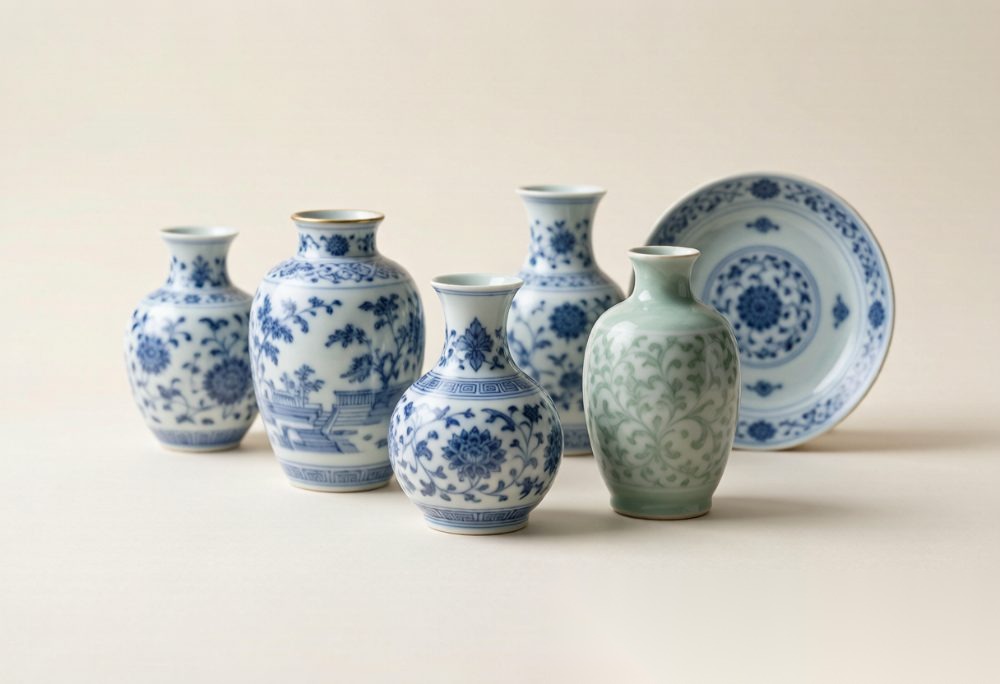
For centuries, Jingdezhen porcelain has been more than a craft — it has been a store of value. From Ming dynasty imperial wares that fetch millions at auction to contemporary studio pieces by rising artisans, the market for Jingdezhen porcelain is as layered as the glazes themselves. Whether you are a serious collector, a retailer sourcing for clients, or an enthusiast looking to make your first meaningful purchase, understanding what drives value in this market is the difference between buying a beautiful object and making a sound investment.
In this guide, we draw on auction data, market trends, and generations of connoisseurship to walk you through the fundamentals of collecting and investing in Jingdezhen porcelain. No fluff — just actionable frameworks you can use the next time you evaluate a piece.
Why Jingdezhen Porcelain Holds Investment Value
Jingdezhen is not just “the Porcelain Capital.” It is a 1,700-year-old continuous production center — a status no other ceramic city in the world can claim. This unbroken lineage creates three pillars of investment value that serious collectors rely on:
1. Historical Provenance as a Premium Signal
Pieces tied to specific imperial reigns, kiln sites, or documented collections carry a provenance premium that can multiply value by 10x or more. A Qianlong-period (1735–1796) famille rose vase with clear imperial workshop markings is not just a vase — it is a historical document. The key metric here is traceability: the more unbroken the chain of ownership, the more confident the market is in pricing.
2. Scarcity of Peak-Period Output
The finest Jingdezhen porcelain was produced in finite quantities — often under direct imperial supervision with strict quality controls that destroyed substandard pieces at the kiln site. This means the surviving output of periods like the Xuande (1426–1435) and Yongzheng (1723–1735) reigns is genuinely scarce. Unlike contemporary art where an artist can always produce more, the supply of antique Jingdezhen porcelain is fixed and declining as pieces enter permanent museum collections.
3. Cultural Capital and Soft Power
Chinese porcelain has been a vehicle of cultural prestige for over a thousand years. As China’s global economic and cultural influence grows, so does international demand for objects that embody that heritage. Major museums — the British Museum, the Met, the Palace Museum — continue to invest in Jingdezhen acquisitions, and institutional validation trickles down to the collector market.
What Determines a Piece’s Value: The 5-Factor Framework
When evaluating any Jingdezhen porcelain piece — antique or contemporary — professionals use a five-factor framework. Each factor interacts with the others; a weakness in one can sometimes be offset by exceptional strength in another, but never ignored.
| Factor | Weight | What to Look For |
|---|---|---|
| Period & Kiln | 25% | Imperial vs. folk kiln; specific reign marks; documented kiln site |
| Condition | 25% | No cracks, chips, or restorations; original glaze integrity; firing flaws vs. damage |
| Rarity | 20% | Unusual forms, experimental glazes, small production runs, documented low survival rate |
| Aesthetic Quality | 20% | Composition, brushwork precision, glaze depth and evenness, overall visual harmony |
| Provenance | 10% | Auction history, previous ownership by known collectors, museum exhibition record |
A common mistake among new collectors is over-weighting period while ignoring condition. A Ming dynasty bowl with a hairline crack can be worth less than a pristine Republic-period (1912–1949) piece of the same form. Condition is never secondary — it is co-equal with period in the eyes of serious buyers.
The Most Investable Periods and Styles
Ming Dynasty (1368–1644): The Blue-Chip Tier
Ming porcelain — especially from the Yongle, Xuande, and Chenghua reigns — represents the blue-chip tier of the Jingdezhen market. Xuande blue-and-white, with its characteristic “heaped and piled” cobalt effect, is the most recognizable and consistently appreciating category. A Xuande blue-and-white bowl that sold for $3 million in 2010 could easily command $8–10 million today.
However, entry barriers are enormous. Authentic Ming imperial pieces rarely appear outside major auction houses, and the risk of sophisticated forgeries is high. For most collectors, the Ming tier is better approached through institutional study — visiting museum collections, attending previews at Sotheby’s and Christie’s, and building visual literacy before attempting a purchase.
Qing Dynasty (1644–1912): The Sweet Spot for Serious Collectors
The Qing period — particularly the Kangxi (1662–1722), Yongzheng (1723–1735), and Qianlong (1736–1795) reigns — offers the best balance of quality, availability, and price appreciation potential for serious private collectors.
- Kangxi: Known for refined blue-and-white with vivid cobalt, often featuring landscapes and narrative scenes. Pieces from this period are relatively more available than Ming wares.
- Yongzheng: The connoisseur’s reign. Yongzheng porcelain is prized for its restrained elegance and technical perfection — particularly monochrome glazes and doucai (contrasting color) decoration. This is the period most admired by Chinese collectors themselves.
- Qianlong: The most flamboyant period, featuring elaborate famille rose palettes, complex forms, and technical virtuosity. Qianlong pieces dominate the top end of auction results.
Within the Qing category, famille rose (fencai) wares from the Yongzheng-Qianlong transition period have shown particularly strong appreciation — roughly 12–15% annually over the past decade according to Art Market Monitor data.
Republic Period (1912–1949): The Undervalued Opportunity
The Republic period is often overlooked by Western collectors, but it is one of the most interesting segments for value-oriented investors. After the fall of the Qing, many former imperial kiln artisans continued working in Jingdezhen, producing technically superb pieces without imperial markings. These pieces combine Qing-level craftsmanship with significantly lower prices.
Key names to know: Wang Bu (王步), the master of blue-and-white who brought a painterly quality to porcelain decoration, and the Eight Friends of Zhushan (珠山八友), a collective of artists who elevated porcelain painting to fine art status. Pieces by these artists have appreciated 300–500% over the past 20 years and still have room to grow as scholarship catches up.
Contemporary Studio Porcelain (2000–Present): The Emerging Market
This is where the most dynamic price action is happening. A new generation of Jingdezhen artists — many trained at the Jingdezhen Ceramic Institute (now Jingdezhen Ceramic University) — are producing limited-edition studio works that bridge tradition and innovation.
What makes contemporary studio porcelain investable:
- Verifiable authenticity: Unlike antiques, contemporary pieces come with direct artist documentation, certificates, and living provenance.
- Lower entry cost: You can acquire a museum-quality piece by a recognized contemporary artist for $500–$5,000, compared to $50,000+ for comparable antique works.
- Active primary market: Artists are alive, producing, and exhibiting — which means you can buy directly from the source, build relationships, and participate in an artist’s career trajectory.
- Institutional recognition: Major museums are increasingly acquiring contemporary Jingdezhen works, which validates the category for collectors.
Artists to watch include those working in innovative glaze chemistry (crystalline glazes, oil-spot tenmoku), large-scale sculptural porcelain, and contemporary reinterpretations of classical forms.
How to Authenticate Jingdezhen Porcelain
Authentication is the single most important skill a collector can develop. Here is a structured approach, from entry-level checks to professional-grade analysis:
Tier 1: Visual Inspection (Do This Every Time)
- Examine the foot rim: The unglazed base reveals the clay body. Genuine Jingdezhen porcelain uses kaolin-rich clay that fires to a fine, white, slightly sugary texture. Overly smooth or grayish bases are red flags.
- Study the mark: Reign marks (nianhao) on the base can be genuine, apocryphal (later tribute marks), or outright forgeries. Learn the calligraphic style of each period — Kangxi marks are typically crisp and angular, while Qianlong marks are more rounded and ornate.
- Check the glaze under magnification: Authentic aged glaze develops a fine network of internal crazing and subtle surface wear that is nearly impossible to replicate artificially. Use a 10x loupe and compare against museum reference photos.
- Assess the weight and ring: Jingdezhen porcelain has a characteristic density. Tap the rim gently with a fingernail — it should produce a clear, bell-like ring. A dull thud suggests cracks, repairs, or non-porcelain composition.
Tier 2: Documentation Review (For Serious Purchases)
- Auction provenance: Request copies of previous auction catalogs or lot descriptions. Reputable houses (Sotheby’s, Christie’s, Poly, China Guardian) maintain searchable archives.
- Thermoluminescence (TL) testing: For high-value antique pieces, TL dating can verify the last time the clay was fired. This is the gold standard for authenticity and costs $500–$1,500 per test — worth it for pieces over $10,000.
- X-ray fluorescence (XRF): XRF analysis can identify the elemental composition of glazes and pigments, which changed predictably across dynasties. Cobalt from the Ming period, for example, typically contains higher manganese and iron than later imported cobalt.
Tier 3: Expert Consultation
For acquisitions above $20,000, consult at least two independent experts — ideally one based in China and one in the West, as they bring complementary perspectives. The Chinese Ceramic Art Appraisal Committee and the Oriental Ceramic Society (London) are good starting points for finding qualified appraisers.
Market Trends to Watch in 2026
Several structural shifts are reshaping the Jingdezhen porcelain market:
- Chinese domestic demand is surging: Wealthy Chinese collectors are repatriating important pieces, driving up prices for top-tier works. Sotheby’s Hong Kong reported that Chinese buyers accounted for over 60% of their ceramics sales in 2025, up from 45% a decade ago.
- Online auctions are democratizing access: Platforms like Catawiki, LiveAuctioneers, and dedicated WeChat auction groups have made mid-tier pieces (under $10,000) accessible to international buyers who cannot attend physical sales in Hong Kong or Beijing.
- Contemporary studio works are institutionalizing: The Victoria and Albert Museum’s 2024 acquisition of several contemporary Jingdezhen pieces signaled that the category is being taken seriously by the museum world. Expect prices to follow.
- Sustainability is becoming a factor: Buyers — particularly in Europe — are increasingly asking about the environmental footprint of porcelain production. Jingdezhen’s traditional wood-fired kilns and hand-processing methods actually align well with sustainability narratives, which could become a marketing advantage.
Building Your Collection: A Practical Roadmap
Phase 1: Education (1–3 Months, $0–$500)
- Visit museum collections: The Shanghai Museum, the Palace Museum (Beijing), and the Jingdezhen Ceramics Museum are essential. In the West, the British Museum and the Met have world-class holdings.
- Read the foundational texts: Chinese Ceramics: From the Paleolithic Period to the Qing Dynasty (He Li) and The Ceramics of China: The Yangshao Culture to the Qing Dynasty (Stacey Pierson).
- Subscribe to auction catalogs from Sotheby’s and Christie’s Asian Art departments — they are free and invaluable for price discovery.
Phase 2: First Acquisitions (3–6 Months, $500–$3,000)
- Start with Republic-period pieces or contemporary studio works where authenticity risk is lower.
- Buy from reputable dealers who offer certificates of authenticity and a return policy.
- Focus on a specific niche — famille rose tea wares, blue-and-white vases, monochrome bowls — rather than buying broadly. Specialization builds expertise faster.
- Document everything: photograph each piece from multiple angles, record purchase details, and start a digital catalog.
Phase 3: Scaling Up (6–18 Months, $3,000–$20,000+)
- Graduate to Qing-period pieces with clear provenance, ideally from documented auction sales.
- Attend previews at major auction houses in person to handle pieces before bidding.
- Consider TL testing for any acquisition over $10,000.
- Explore direct sourcing from Jingdezhen — visiting the city, meeting artists, and buying from studio kilns can yield pieces with strong investment potential at below-gallery prices.
Common Mistakes That Cost Collectors Money
Learn from others’ errors. These are the most expensive mistakes we see in the Jingdezhen market:
- Buying the story, not the object: A dealer’s narrative about a piece’s history is meaningless without documentation. Verify first, pay later.
- Ignoring restoration: Professional restoration can be so seamless that even experienced collectors miss it. Always ask explicitly: “Has this piece undergone any restoration, repair, or overpainting?” Get the answer in writing.
- Overpaying for “museum quality” on eBay: If a listing uses hyperbolic language (“MUSEUM QUALITY!!! RARE!!!”) and the price seems too good to be true, it is. Serious dealers do not sell through sensationalist listings.
- Neglecting insurance and storage: A $20,000 vase sitting on an unsecured shelf is a disaster waiting to happen. Invest in proper display cases with UV-filtering glass and maintain a detailed insurance rider.
- Skipping market research: Before buying, check comparable sales on LiveAuctioneers, Invaluable, or the auction house’s own price database. If a piece is priced 50% above recent comparables without a clear justification, walk away.
Frequently Asked Questions
Is Jingdezhen porcelain a good investment compared to stocks or real estate?
Porcelain is an alternative asset — it should complement, not replace, traditional investments. Top-tier antique Jingdezhen porcelain has historically appreciated at 8–15% annually over long holding periods (10+ years), with lower volatility than stocks. However, it is illiquid, requires specialized knowledge, and incurs transaction costs (auction house premiums of 20–25%). Treat it as a passion investment with genuine financial upside, not a get-rich-quick scheme.
How do I start collecting with a $1,000 budget?
Focus on contemporary studio porcelain from recognized Jingdezhen artists. For $200–$500, you can acquire a signed, limited-edition tea bowl or small vase directly from an artist’s studio. For $500–$1,000, look for Republic-period blue-and-white pieces or larger contemporary works from emerging artists. Build relationships with the artists — a piece bought directly from an artist you’ve met in Jingdezhen carries personal and investment value that an anonymous eBay purchase never will.
What is the safest period to invest in right now?
The Yongzheng period (1723–1735) offers the strongest combination of market recognition, aesthetic quality, and relative availability. Yongzheng pieces are less expensive than Qianlong works but are considered by connoisseurs to be technically superior. For those with smaller budgets, the Republic period (1912–1949) and contemporary studio works offer the best risk-reward profile.
Should I buy from auctions, galleries, or directly from Jingdezhen?
Each channel has its place. Auctions offer the widest selection and transparent pricing, but premiums are high and you need expertise to avoid overpaying. Galleries provide curation and authentication, at a markup of 30–50% over auction prices. Direct sourcing from Jingdezhen offers the best value for contemporary works and can be an unforgettable experience — but you need Mandarin skills or a trusted local guide. A diversified approach across all three channels is ideal.
Where to Go from Here
Collecting Jingdezhen porcelain is a lifelong pursuit that rewards patience, curiosity, and relationship-building. The pieces you acquire are not just objects — they are connections to a 1,700-year tradition of human creativity, technical mastery, and cultural exchange.
At Zhejiang Ceramics, we work directly with Jingdezhen kilns and artists to bring authentic, investment-grade porcelain to collectors, retailers, and hospitality buyers worldwide. Whether you are looking for a single statement piece or building a comprehensive collection, we are here to help you navigate the market with confidence.
Ready to start or expand your collection? Contact us to discuss your interests, or browse our current inventory of curated Jingdezhen porcelain — every piece comes with full documentation and our authenticity guarantee.
Discover more from Zhejiang Ceramics (Jingdezhen)
Subscribe to get the latest posts sent to your email.